Quick Summary
Summarize this article instantly with your preferred AI model.
Brand vs Direct Response Advertising: Why B2B Needs Both
Brand vs Direct Response Advertising: Why B2B Needs Both
Brand advertising builds awareness, perception, and preference over time, while direct response advertising drives immediate action — leads and conversions you can measure now — and effective B2B marketing needs both, because they do different jobs that reinforce each other. Direct response captures demand that exists; brand builds the awareness and preference that makes that demand exist and makes direct response more effective. The common mistake is over-investing in direct response because it’s immediately measurable, while starving brand because its payoff is delayed and harder to measure — which weakens results over time as the demand that direct response captures isn’t being replenished. This guide covers brand vs direct response advertising and why B2B needs both.
Key takeaways
- Brand advertising builds awareness, perception, and preference over time.
- Direct response drives immediate, measurable action — leads and conversions.
- They do different jobs — brand builds demand and preference, direct response captures it.
- B2B needs both — brand makes direct response more effective, and direct response captures demand now.
- Over-investing in direct response starves brand, whose delayed payoff compounds — weakening long-term results.
What’s the difference between brand and direct response?
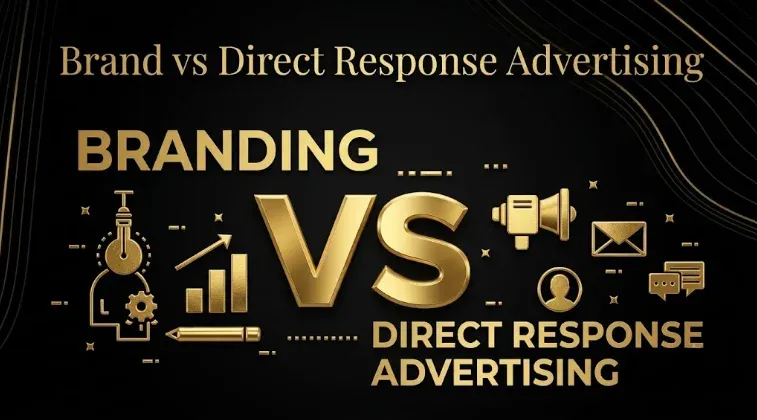
Brand builds long-term awareness and preference; direct response drives immediate action. Brand advertising works over time to build awareness of you, shape how you’re perceived, and create preference — it’s about making people know, remember, and think well of you, which pays off downstream as that awareness and preference influence future decisions. It’s a longer-term investment whose effects accumulate, and it’s harder to measure directly because its impact is diffuse and delayed. Direct response advertising works to drive an immediate action — a click, a lead, a conversion — right now, so its effects are immediate and directly measurable.
| Brand advertising | Direct response | |
|---|---|---|
| Goal | Awareness, perception, preference | Immediate action |
| Timeframe | Long-term, compounding | Immediate |
| Measurability | Harder, diffuse, delayed | Direct, immediate |
| Role | Builds and creates demand | Captures demand |
So the two are fundamentally different in goal, timeframe, and measurability. Brand builds the awareness and preference that shape future demand; direct response captures demand into immediate action. Neither is a substitute for the other, because they do different things — building demand versus capturing it — on different timeframes. Understanding this distinction is the foundation for seeing why B2B needs both and how they work together.
Why does B2B need both?
Because brand builds the demand and preference that direct response captures, so they’re complementary. Direct response is effective at capturing demand — turning existing awareness and preference into immediate action — but it depends on there being demand and preference to capture. Brand advertising builds that: by creating awareness and preference over time, it makes people more likely to respond when direct response reaches them, because people respond better to companies they already know and think well of. So brand makes direct response more effective, and direct response captures the demand brand helps create.
This complementarity means over-relying on one weakens the whole. Direct response without brand captures existing demand but doesn’t build new demand or preference, so it works a fixed pool that isn’t being replenished, and it’s less effective because it’s reaching people who don’t already know you. Brand without direct response builds awareness and preference but doesn’t capture it into action. B2B needs both because building demand (brand) and capturing it (direct response) are both necessary for a healthy, sustainable result — brand creating and strengthening the demand, direct response converting it. Recognizing that they work together, each enabling the other, is why effective B2B marketing invests in both rather than choosing one.
Why is direct response over-favored?
Because it’s immediately measurable, while brand’s payoff is delayed and harder to measure, biasing investment toward direct response. Direct response produces clear, immediate metrics — leads, conversions, cost per lead — that are easy to see and attribute, making it satisfying to invest in and easy to justify. Brand advertising’s payoff, by contrast, is delayed (it builds over time) and diffuse (harder to attribute to specific results), so it’s harder to measure and justify, making it easy to under-invest in. This measurability asymmetry biases marketers toward direct response — the measurable, immediate option — and away from brand — the delayed, hard-to-measure one.
But this bias is a trap, because under-investing in brand means not building the demand and preference that sustain results. A marketing program heavy on direct response and light on brand captures existing demand efficiently but doesn’t replenish it, so over time, as the fixed pool of existing demand and awareness is worked through without brand rebuilding it, results plateau or decline — the direct response becomes less effective because there’s less warm demand to capture. So the measurability of direct response, while real, shouldn’t drive you to starve brand, because brand’s delayed, compounding payoff is what keeps the demand direct response captures flowing. This connects to the broader theme that some of the most valuable marketing builds over time and pays off downstream: brand is exactly that, so favoring only the immediately-measurable direct response undervalues the brand-building that sustains long-term results.
The brand vs direct response framework
Balance brand and direct response deliberately:
- Understand the difference — brand builds awareness and preference over time; direct response drives immediate action.
- Invest in both — B2B needs demand-building (brand) and demand-capturing (direct response).
- Recognize brand enables direct response — people respond better to companies they know and prefer.
- Don’t over-favor direct response — its measurability shouldn’t starve brand’s delayed, compounding payoff.
- Measure them differently — direct response on immediate metrics, brand on longer-term awareness and preference.
How do brand and direct response work together over time?
Brand builds and strengthens demand and preference continuously, while direct response captures it, so together they create a sustainable engine. Over time, brand advertising steadily builds awareness and preference — more people know you, remember you, and think well of you — which grows the pool of warm demand and makes everyone more receptive to your direct response. Direct response then captures that demand into immediate action, converting the awareness and preference brand built. As this continues, brand keeps replenishing and strengthening the demand that direct response captures, so results are sustainable rather than a diminishing harvest of a fixed pool. This is the engine: brand creates and grows demand and preference on an ongoing basis, direct response converts it, and the two reinforce each other over time — brand making direct response more effective, direct response monetizing brand’s investment. This connects to the demand generation and capture distinction: brand is largely demand-creation (building awareness and preference), direct response is largely demand-capture, and a healthy program does both continuously. It also relates to measuring LinkedIn’s full contribution: brand’s value is often understated by immediate, direct metrics because it pays off downstream, so appreciating brand requires looking beyond immediate response to the awareness and preference it builds over time. B2B marketing that balances brand and direct response — investing in both, understanding their complementary roles, and measuring each appropriately — builds a sustainable engine where demand is continually created and captured, which outperforms an over-reliance on direct response that captures existing demand without replenishing it, or brand alone that builds preference without converting it.
Frequently Asked Questions
Q1. What’s the difference between brand and direct response advertising?
Brand advertising builds awareness, perception, and preference over time — a long-term, compounding, harder-to-measure investment — while direct response drives immediate, measurable action like leads and conversions. They do different jobs: brand builds and creates demand and preference, direct response captures demand into action. Neither substitutes for the other, since building demand and capturing it are different things on different timeframes.
Q2. Why does B2B need both brand and direct response?
Because brand builds the demand and preference that direct response captures, so they’re complementary. Direct response captures existing demand but depends on there being demand and preference to capture, which brand builds. Brand makes direct response more effective, since people respond better to companies they know, and direct response captures the demand brand helps create. Both building and capturing demand are necessary for sustainable results.
Q3. Why is direct response over-favored?
Because it’s immediately measurable — clear metrics like leads and conversions that are easy to see, attribute, and justify — while brand’s payoff is delayed and diffuse, harder to measure and justify. This measurability asymmetry biases investment toward direct response and away from brand. But it’s a trap, since under-investing in brand means not building the demand and preference that sustain results over time.
Q4. What happens if you only do direct response?
You capture existing demand efficiently but don’t build new demand or preference, so you work a fixed pool that isn’t replenished, and it’s less effective because you’re reaching people who don’t already know you. Over time, as the pool of existing demand is worked through without brand rebuilding it, results plateau or decline, since direct response becomes less effective with less warm demand to capture.
Q5. How does brand advertising help direct response?
By building the awareness and preference that make people more likely to respond. People respond better to companies they already know and think well of, so brand’s awareness and preference make direct response more effective when it reaches those people. Brand grows the pool of warm demand and makes everyone more receptive, so direct response captures more, converting the awareness and preference brand built into immediate action.
Q6. How do you measure brand vs direct response?
Differently, because of their different timeframes. Direct response is measured on immediate metrics — leads, conversions, cost per lead — that are directly attributable. Brand is measured on longer-term signals — awareness, perception, preference — since its payoff is delayed and diffuse. Measuring brand on immediate response metrics understates it, because its value is building future demand and preference rather than driving immediate action now.
Q7. Should you prioritize brand or direct response?
Neither exclusively — B2B needs both, balanced. Direct response captures demand now, which is necessary, but over-favoring it starves brand, whose delayed, compounding payoff sustains the demand direct response captures. Brand builds the awareness and preference that keep results flowing, so it shouldn’t be neglected for the more measurable direct response. Balance both, investing in demand-building and demand-capturing, rather than prioritizing one at the other’s expense.
Q8. How do brand and direct response work together over time?
Brand continuously builds and strengthens demand and preference, while direct response captures it, creating a sustainable engine. Brand grows the warm demand and makes people receptive; direct response converts it into action; and brand keeps replenishing what direct response captures, so results are sustainable rather than a diminishing harvest. The two reinforce each other — brand making direct response more effective, direct response monetizing brand’s investment — over time.
More Featured Blogs
View All Blogs
Broad vs Narrow Targeting on LinkedIn: Finding the Right Breadth



Understanding Cost Per Lead (CPL) on LinkedIn
How to Use Thought Leadership in Your LinkedIn Ads