Quick Summary
Summarize this article instantly with your preferred AI model.
How to Use LinkedIn Ads With SEO and Content Marketing
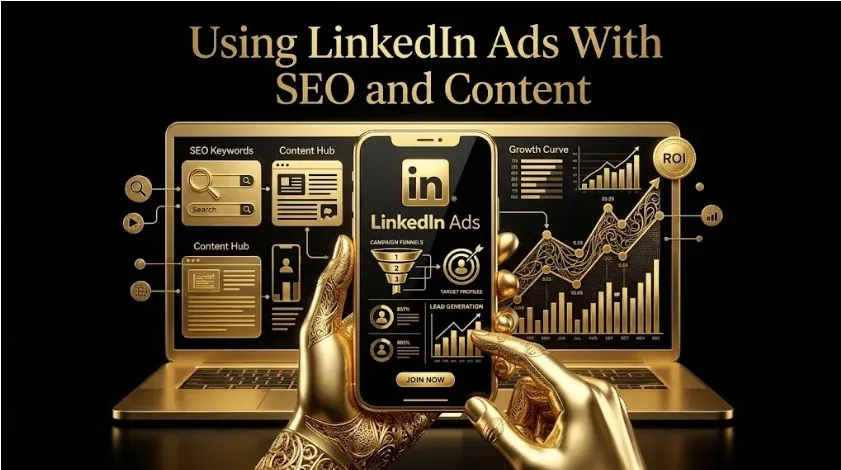
How to Use LinkedIn Ads With SEO and Content Marketing
LinkedIn Ads, SEO, and content marketing work best as a reinforcing system, not three separate programs — LinkedIn creates demand that SEO then captures, content fuels both, and each makes the others more effective. Most teams run them in silos, with separate owners and separate metrics, and miss the compounding effect of coordinating them. The core relationship is simple: SEO captures demand that already exists (people searching), LinkedIn creates demand among people who aren’t searching yet, and content is the raw material both distribute. When LinkedIn builds awareness, it shows up later as branded searches that SEO captures — which is exactly the kind of contribution last-click erases. This guide covers how the three channels reinforce each other and how to coordinate them.
Key takeaways
- LinkedIn Ads, SEO, and content reinforce each other — coordinate them rather than siloing.
- SEO captures existing demand; LinkedIn creates demand among people not yet searching.
- Content is the raw material both channels distribute — LinkedIn amplifies it, SEO ranks it.
- LinkedIn’s demand creation shows up as branded search that SEO captures — often credited to search, not LinkedIn.
- Measure the three holistically, since their contributions flow into each other.
How do the three channels relate?
Each does a distinct job, and they hand off to each other. SEO captures demand that already exists — people actively searching for solutions, whom you meet at the moment of intent. LinkedIn Ads create demand among the far larger group who aren’t searching yet, building awareness and familiarity so they eventually do. Content marketing produces the material both channels rely on — the articles, research, and points of view that SEO ranks and LinkedIn distributes.
The relationship is a cycle. LinkedIn builds awareness and demand; that demand surfaces as searches, which SEO captures; the content that ranks in search and gets distributed on LinkedIn builds authority that makes both work better. Run in isolation, each channel underperforms its potential; coordinated, they compound.
How does LinkedIn advertising help SEO?
By creating the demand that becomes search traffic. When LinkedIn ads build awareness of your brand and category among your target audience, some of those people later search — for your brand by name, or for the category you’ve associated yourself with — and that search traffic is what SEO captures. LinkedIn effectively feeds the top of the search funnel by creating branded and category demand that didn’t exist before.
This is also why the two channels are hard to measure separately with last-click. Someone sees your LinkedIn ads for weeks, then searches your brand and converts through an organic or paid search result — and last-click credits search, erasing LinkedIn’s role in creating the search in the first place. The channels are more connected than siloed reporting suggests, which is an argument for measuring them holistically rather than crediting whichever came last.
| Channel | Job | Demand |
|---|---|---|
| SEO | Capture people actively searching | Existing |
| LinkedIn Ads | Build awareness among non-searchers | Created |
| Content | Fuel both — rank and distribute | Both |
How does content connect the two?
By being the asset both channels deploy. A strong piece of content — original research, a point of view, a practical guide — can rank in search to capture demand, and be distributed on LinkedIn to build demand, from the same underlying work. Content is the shared input: SEO optimizes it to be found by searchers, and LinkedIn amplifies it to reach a targeted audience who aren’t searching.
This means content investment pays off across both channels at once. Rather than producing content for SEO and separate content for LinkedIn, you produce genuinely valuable content and deploy it through both — ranking it for search demand and distributing it for created demand. The better the content, the more it does for both channels, which is why content quality underpins the whole system.
The coordinated-channel framework
Run the three as a reinforcing system:
- Produce genuinely valuable content — the shared raw material both SEO and LinkedIn deploy.
- Optimize it for search so it captures the demand that already exists.
- Distribute it on LinkedIn to build demand among your targeted audience who aren’t searching yet.
- Expect LinkedIn to feed search — awareness it builds surfaces as branded and category searches SEO captures.
- Measure holistically — account for the demand LinkedIn creates that converts through search, rather than crediting last-click.
Why measure these channels together?
Because measuring them separately, especially on last-click, systematically misattributes their contributions. LinkedIn’s demand creation converts through search and direct traffic that last-click credits to those channels, making LinkedIn look weaker and search stronger than reality. If you judge LinkedIn purely on its own last-click conversions, you’ll under-credit it and potentially cut the channel that’s feeding your search traffic — then watch branded search decline. The honest approach is to measure the system holistically: track whether LinkedIn investment correlates with rising branded search and direct traffic, use account-level or multi-touch measurement to see the full path, and recognize that the channels’ contributions flow into each other. Coordinated channels need coordinated measurement, or you’ll optimize each in isolation and break the reinforcing effect that makes them valuable together.
Frequently Asked Questions
Q1. How do LinkedIn Ads, SEO, and content marketing work together?
They reinforce each other: SEO captures demand that already exists among searchers, LinkedIn creates demand among people not yet searching, and content is the raw material both distribute. LinkedIn’s awareness surfaces as branded searches SEO captures, and content that ranks and gets distributed builds authority for both. Coordinated, they compound; siloed, each underperforms.
Q2. Does LinkedIn advertising help SEO?
Yes, by creating the demand that becomes search traffic. LinkedIn ads build brand and category awareness among people who aren’t searching yet, and some of them later search — for your brand or category — which SEO captures. LinkedIn feeds the top of the search funnel by creating branded and category demand that didn’t previously exist.
Q3. What is the difference between SEO and LinkedIn Ads for demand?
SEO captures demand that already exists — people actively searching, met at the moment of intent. LinkedIn Ads create demand among the far larger group not yet searching, building awareness so they eventually do. SEO harvests existing demand; LinkedIn generates new demand. They cover different parts of the funnel and hand off to each other.
Q4. How does content marketing connect LinkedIn and SEO?
Content is the shared asset both channels deploy. A strong piece can rank in search to capture demand and be distributed on LinkedIn to build demand, from the same work. SEO optimizes it to be found by searchers; LinkedIn amplifies it to a targeted audience not searching. Good content pays off across both channels simultaneously.
Q5. Why does LinkedIn look weaker than search in reporting?
Because last-click credits the final touch, and LinkedIn’s demand creation often converts through search or direct traffic that gets the credit. Someone sees LinkedIn ads for weeks, then searches your brand and converts through search — and last-click erases LinkedIn’s role in creating that search. Siloed, last-click reporting understates LinkedIn and overstates search.
Q6. Should you use the same content for LinkedIn and SEO?
Often yes — produce genuinely valuable content and deploy it through both, ranking it for search demand and distributing it on LinkedIn for created demand. This makes content investment pay off across both channels at once, rather than producing separate content for each. The better the content, the more it does for the whole system.
Q7. How do you coordinate paid, search, and content channels?
Produce valuable content as the shared input, optimize it for search to capture existing demand, distribute it on LinkedIn to create demand among non-searchers, expect LinkedIn to feed branded and category search, and measure holistically. The key is treating them as one reinforcing system with shared content and coordinated measurement, not three separate programs.
Q8. How do you measure LinkedIn Ads, SEO, and content together?
Measure the system holistically rather than crediting last-click. Track whether LinkedIn investment correlates with rising branded search and direct traffic, use account-level or multi-touch measurement to see the full path, and recognize the channels’ contributions flow into each other. Measuring separately on last-click misattributes LinkedIn’s demand creation to the search that captures it.
More Featured Blogs
View All Blogs
LinkedIn Ads for Founders & Early-Stage B2B SaaS


Stop Optimizing Your LinkedIn Ads for CTR
B2B SaaS LinkedIn Ad Examples That Convert (2026)