Quick Summary
Summarize this article instantly with your preferred AI model.
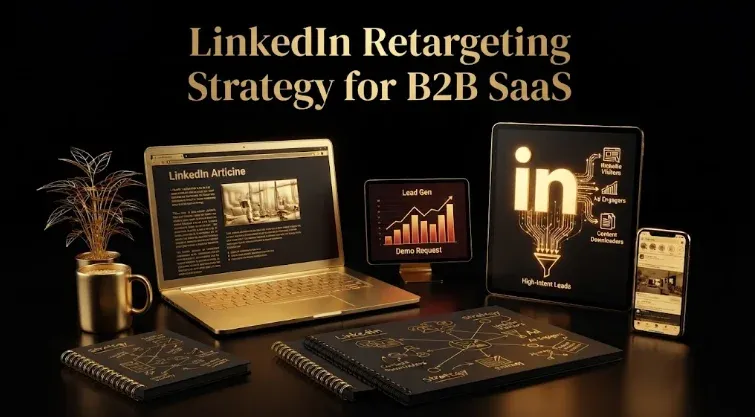
LinkedIn Retargeting Strategy for B2B SaaS
LinkedIn Retargeting Strategy for B2B SaaS
Retargeting is where most B2B pipeline is actually won — not because it finds new buyers, but because it keeps the warm ones engaged across a 90–180 day consideration window they’d otherwise drift out of. A prospect visits your pricing page, disappears for six weeks, sees a competitor, and comes back only if you stayed in front of them. The difference between retargeting that drives pipeline and retargeting that quietly wastes budget comes down to four things: segmenting warm audiences by intent (not just “visited website”), sequencing creative across time windows, capping frequency, and measuring on pipeline rather than cost per lead. This guide covers the retargeting strategy that turns warm interest into pipeline.
Key takeaways
- Retargeting re-engages warm prospects across the long B2B cycle — higher CTR and conversion, lower cost per opportunity.
- Segment by intent and stage, not just “visited website” — a pricing-page visitor is not a blog reader.
- Sequence creative across 7/30/90-day windows and match it to stage — cold creative on warm audiences is the top mistake.
- Cap frequency — small retargeting pools routinely overshoot to 15–20+ impressions/week without a cap.
- Measure on pipeline — cost per opportunity and account engagement lift, using account-level (not cookie-level) data.
Why retargeting matters for B2B SaaS
Most B2B SaaS deals don’t close on a first visit — buyers research, compare, consult colleagues, and return multiple times over months before acting. Without a deliberate retargeting layer, your pipeline leaks at every gap: the prospect who read a blog, the one who watched half your demo video, the one who abandoned a form. Retargeting is the infrastructure that keeps those warm prospects engaged across the consideration window instead of losing them to the competitor who stayed visible.
And it beats cold on the metrics that matter. Because you’re reaching people who already know your brand, click-through rates climb, conversion rates improve (your message builds on prior context), and cost per opportunity drops versus spraying budget across cold traffic. The foundation is the LinkedIn Insight Tag — without it installed and firing, you can’t build website-based retargeting audiences at all, so that’s step zero.
Segment by intent, and layer for scale
Stop treating “visited the website” as one audience. Different actions signal different intent, and each deserves different treatment:
| Audience | Intent | Best next step |
|---|---|---|
| Pricing / demo page visitors | High | Case study or testimonial + demo CTA |
| Service / product page visitors | Medium-high | Proof + consideration offer |
| Blog / content readers | Low-medium | Lighter content, keep warm |
| Video viewers (50%+) | Medium | A more direct conversion message |
| Lead Gen Form abandoners | High | Re-serve the Lead Gen Form (recovers up to ~30%) |
| Company Page / ad engagers | Organic interest | Nurture toward a first conversion |
Two practical notes. Form abandoners are the highest-ROI audience you’re probably ignoring — re-serving a pre-filled Lead Gen Form to people who abandoned a submission recovers up to ~30% of them, because you’re removing the friction that stopped them. And layer audiences for scale: a single retargeting segment often lacks the reach to run efficiently, so combine several warm signals (website visitors + video viewers + form engagement + Page engagers) into one campaign to reach enough scale while staying warm. If you also retarget from uploaded contact or company lists, expect ~30–70% match rates depending on data quality.
Sequence creative across time windows
Use 7-day, 30-day, and 90-day windows to separate hot, warm, and nurture audiences — but treat them as a sequence, not three static pools, so a prospect moves through a deliberate arc rather than seeing the same ad for three months:
- Days 1–7 (hot): the most direct ask — a demo/consultation CTA paired with a case study, aimed at recent high-intent visitors while they’re still in-market.
- Days 8–30 (warm): proof and objection-handling — testimonials, a comparison, a quantified result — reinforcing the reasons to choose you.
- Days 31–90 (nurture): lighter touches — a relevant guide, original data, a founder POV — that keep you present without pushing, so you’re top-of-mind when they re-enter the market.
This windowed sequence also controls urgency and budget: you spend more, and more directly, on the freshest visitors, and taper to lighter nurture as recency fades — instead of spending equally on someone who visited yesterday and someone who visited three months ago.
Match creative to the stage (the #1 mistake)
The most common retargeting failure — and a direct cause of underperformance — is running cold-prospecting creative against warm retargeting audiences. Someone who visited your pricing page doesn’t need a “here’s what we do” awareness ad; they need the case study, comparison, or demo CTA that answers the question they were already asking. Match format to stage too: Sponsored Content is the versatile workhorse (awareness through conversion); video suits moderate-interest audiences and generates new video-viewer segments; Lead Gen Forms recover form abandoners; Conversation Ads suit bottom-funnel demo asks. Refresh warm-audience creative regularly so frequency doesn’t numb the small pools.
Cap frequency and set the budget split
Frequency caps are essential, especially on small retargeting pools, because uncapped campaigns routinely overshoot into brand-damaging territory — 15–20+ impressions per member per week — annoying the exact prospects you’re trying to win. Cap frequency (around five per week is a reasonable start) so you stay present without becoming the ad everyone’s sick of. And set a sensible budget split: roughly 70/30 (or 60/40) prospecting-to-retargeting is a reasonable starting point — enough to keep warm audiences engaged without starving demand creation. The optimal ratio depends on your audience pool size and sales cycle length; retargeting audiences are finite, so over-allocating to a small pool just drives up frequency.
Measure retargeting on pipeline (account-level)
Retargeting is where measuring the right thing matters most, because a warm audience will always post a flattering CTR and low CPL — that’s not the point. Judge retargeting on cost per opportunity, account engagement lift, and pipeline influence, not cost per lead. And move beyond cookie-level page-visit vanity to account-level intelligence: individual page visits can mislead, while account-level engagement (are the accounts you care about moving through stages) is the truer signal, so sync LinkedIn audiences with your CRM and real buying signals where you can. Feed offline conversions and closed-won back to LinkedIn (via conversions API / CRM sync) so the platform — and you — can see which retargeting actually produces pipeline, not just clicks. Retargeting that lifts account engagement and produces opportunities is working even if its surface metrics look ordinary; retargeting with great CTR that doesn’t move accounts is not.
If you’d rather have this built and run for you, book a demo.
Frequently Asked Questions
Q1. What is a good LinkedIn retargeting strategy for B2B SaaS?
Segment warm audiences by intent (not just “visited website”), sequence creative across 7/30/90-day windows so prospects move through a deliberate arc, cap frequency so small pools aren’t overexposed, and match creative to each segment’s stage. Layer several warm signals into one campaign for scale, split budget roughly 70/30 prospecting-to-retargeting to start, and measure on cost per opportunity and pipeline influence using account-level (not cookie-level) data.
Q2. Does LinkedIn retargeting work better than cold campaigns?
Yes, on the metrics that matter — reaching people who already know your brand lifts click-through and conversion rates and lowers cost per opportunity versus cold traffic. Retargeting doesn’t find new buyers; it keeps warm ones engaged across the long B2B cycle so they don’t drift to a competitor. It’s most powerful as the capture-and-nurture layer paired with cold prospecting that fills the top of the funnel — the two work together, not instead of each other.
Q3. How should you segment LinkedIn retargeting audiences?
By the intent each action signals: pricing/demo visitors are high-intent (case studies + demo CTAs), service-page visitors medium-high, blog readers low-medium (lighter content), video viewers medium (a direct message), and Lead Gen Form abandoners high-intent (re-serve the form, recovering up to ~30%). Treating all site visitors as one audience wastes the signal. On smaller pools, layer several warm signals — visitors, video viewers, form engagement, Page engagers — into one campaign for enough scale.
Q4. How should you sequence LinkedIn retargeting over time?
Use 7/30/90-day windows as a sequence, not static pools: days 1–7 (hot) get the most direct ask (demo CTA + case study) while visitors are still in-market; days 8–30 (warm) get proof and objection-handling (testimonials, comparisons, results); days 31–90 (nurture) get lighter touches (guides, data, founder POV) to stay top-of-mind. This spends more, and more directly, on the freshest visitors and tapers as recency fades, matching your cadence to the 90–180 day B2B consideration window.
Q5. Do you need frequency caps on LinkedIn retargeting?
Yes — essential, especially on small pools, because uncapped campaigns routinely overshoot to 15–20+ impressions per member per week, damaging brand perception and performance by annoying the exact prospects you want. Cap frequency (around five per week is a reasonable start) so you stay present across the consideration window without becoming the ad everyone’s tired of. Small warm pools overexpose fast, so the cap protects both brand and budget — pair it with a budget split sized to the audience.
Q6. What creative should you use for LinkedIn retargeting?
Creative matched to the audience’s stage — running cold-prospecting creative at warm audiences is the top mistake. High-intent visitors (pricing/demo) get Sponsored Content with a case study, testimonial, or demo CTA; lower-intent readers get lighter content; moderate-interest audiences respond to short video; form abandoners get re-served Lead Gen Forms; bottom-funnel gets Conversation Ads. Sponsored Content is the versatile workhorse, but creative and audience stage must line up, refreshed regularly so small pools don’t fatigue.
Q7. How much budget should go to LinkedIn retargeting?
A reasonable starting split is roughly 70/30 (or 60/40) prospecting-to-retargeting — enough to keep warm audiences engaged without starving the demand creation that fills the funnel. The optimal ratio depends on audience pool size and sales cycle length: longer cycles and larger warm pools justify more retargeting weight. Retargeting audiences are finite, so over-allocating to a small pool just drives up frequency past useful levels; size the retargeting budget to the audience it actually has.
Q8. How do you measure LinkedIn retargeting performance?
On cost per opportunity, account engagement lift, and pipeline influence — not cost per lead or CTR, which warm audiences inflate by default. Move from cookie-level page-visit metrics to account-level intelligence (sync LinkedIn audiences with CRM and buying signals), since individual visits can mislead, and feed offline conversions and closed-won back via CRM/conversions API. Retargeting that lifts account engagement and produces opportunities is working even if surface metrics look ordinary; great CTR that doesn’t move accounts toward pipeline is not.
More Featured Blogs
View All Blogs
LinkedIn Ads vs Cold Outbound for B2B SaaS



How to Use AI for LinkedIn Audience & ICP Research
LinkedIn Ads Account Structure & Naming Convention for B2B SaaS