Quick Summary
Summarize this article instantly with your preferred AI model.
LinkedIn Predictive Audiences vs Matched Audiences vs Lookalikes: What Changed in 2024 and How to Use Each in 2026
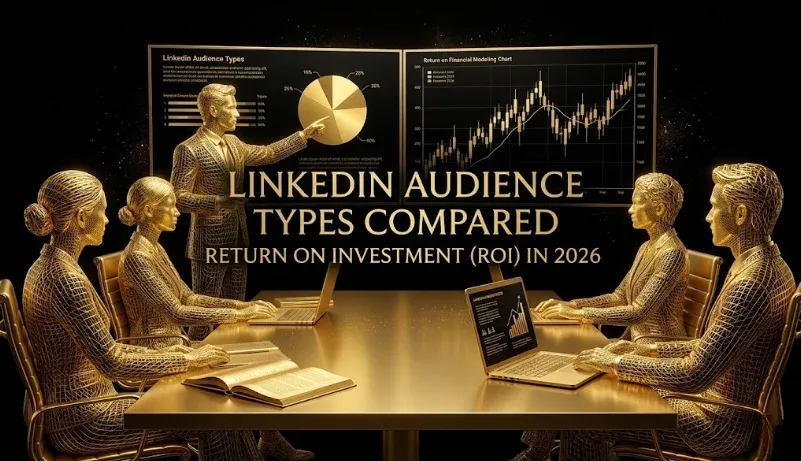
LinkedIn replaced Lookalike Audiences with Predictive Audiences in February 2024. Predictive Audiences use LinkedIn’s machine learning to find new prospects similar to a seed audience (CRM closed-won list, Matched Audience, or Lead Gen Form submitters) — delivering 21% lower CPL than standard targeting. Matched Audiences target your own data directly (company lists, contacts, website visitors). Predictive Audiences expand beyond your data using ML. Use Matched for ABM precision; use Predictive for scaling beyond your existing audience.
Key Takeaways
- LinkedIn discontinued Lookalike Audiences during the 2024-2025 transition. Predictive Audiences replaced them in February 2024.
- Predictive Audiences deliver 21% lower CPL than LinkedIn’s standard demographic targeting when built from a high-quality CRM seed.
- Matched Audiences target your own data (company lists, contact lists, website visitors). Predictive Audiences use ML to find similar prospects beyond your data.
- The best seed for Predictive Audiences is your CRM closed-won list — not your MQL list. Quality of seed determines quality of output.
- Predictive Audiences need a minimum of 300 source members and produce expanded audiences of 5,000-300,000 members typically.
- For ABM, lead with Matched Audiences. For scaling beyond your target accounts, layer in Predictive Audiences.
The 2024 Shift: Why Lookalikes Were Discontinued
In February 2024, LinkedIn quietly deprecated Lookalike Audience creation and rolled out Predictive Audiences as the replacement. The migration completed across most accounts during 2024-2025.
What Lookalikes were: LinkedIn’s original audience-expansion mechanism. You provided a seed audience (typically a Matched Audience list of customers or high-value contacts), and LinkedIn’s algorithm found “similar” LinkedIn members — based on profile attributes like job title, industry, company size, and engagement patterns.
Why LinkedIn replaced them: Lookalikes worked by clustering members on shared attributes — but this was a relatively simple ML approach by 2024 standards. Modern conversion-prediction models can incorporate dramatically more signals: engagement velocity, browsing patterns across LinkedIn, content consumption history, organic posting behavior, and downstream conversion outcomes from the seed audience’s similar profiles.
What Predictive Audiences are: A modernized ML system trained on conversion outcomes rather than just profile similarity. The system looks at your seed audience (e.g., closed-won customers) and identifies LinkedIn members who exhibit patterns predictive of converting to similar outcomes — not just members who look similar on profile attributes.
The output: 21% lower CPL than standard demographic targeting, according to LinkedIn’s own benchmarks.
Matched Audiences vs Predictive Audiences: What Each Does
| Feature | Matched Audiences | Predictive Audiences |
|---|---|---|
| What it targets | Your own data (CRM lists, website visitors) | ML-expanded audience based on a seed |
| Source data required | Company list, contact list, website visitors, or engagement data | A seed Matched Audience or CRM list |
| Audience size | Typically 300-50,000 | Typically 5,000-300,000 |
| Match precision | Exact (your defined list) | Predictive (ML similarity to seed) |
| Best for | ABM, retargeting, customer expansion | Scaling beyond your existing target list |
| Setup time | 24-48 hours | 24-72 hours after seed audience |
| Refresh cadence | Manual (you reupload lists) | Automatic (LinkedIn re-trains on seed) |
| CPL vs cold targeting | 30-50% lower | 21% lower |
The key difference: Matched Audiences reach the exact people in your data. Predictive Audiences reach new people who look like converters from your data. Both have their place — they’re not substitutes.
When to Use Matched Audiences
Use Matched Audiences when:
- You’re running ABM. Company Lists give you exact targeting against your target account list. Predictive Audiences would expand beyond your TAL — defeating the purpose of ABM.
- You’re targeting current customers. Contact Lists let you reach known buyers for upsell, expansion, or feature-adoption campaigns.
- You’re retargeting website visitors. Website retargeting audiences are built from Insight Tag data — pure Matched, not Predictive.
- Your seed data is small (under 1,000 records). Below this, Predictive Audience ML doesn’t have enough signal to expand effectively.
- You need exact targeting precision. ABM, account-tier campaigns, customer-specific creative — all require Matched Audiences.
When to Use Predictive Audiences
Use Predictive Audiences when:
- You’re scaling beyond your existing target list. Once you’ve saturated impressions to your 500-account TAL, Predictive Audiences let you reach similar accounts beyond the list.
- You’re entering a new vertical or geography. Build a Predictive Audience from your existing customer base, expanded to the new market.
- Your conversion data is rich. With 500+ CRM closed-won records as a seed, Predictive Audiences produce dramatically better results than from a 50-record seed.
- You want LinkedIn’s algorithm to do the discovery work. When you don’t know exactly which job titles or industries to target, Predictive Audiences surface patterns you might miss.
- You need volume for the LinkedIn algorithm. Predictive Audiences typically produce 50,000-300,000 member audiences — enough volume for the algorithm to optimize delivery.
The Best Seed for Predictive Audiences
The single biggest determinant of Predictive Audience quality is what you feed it as a seed. Quality of seed determines quality of output.
Ranked by seed quality:
| Seed Audience | Seed Quality | Why |
|---|---|---|
| CRM Closed-Won List | Highest | Real revenue outcomes; LinkedIn ML trains on actual buyers |
| Lead Gen Form Submitters (SQLs) | High | Strong intent signal from your own funnel |
| Pricing Page Visitors | High | Strong intent signal from website behavior |
| High-Value Customer Contact List | High | Existing customers signal product-market fit |
| All MQLs | Medium | Mixed quality; some MQLs never converted |
| Lead Gen Form Submitters (all) | Medium | Includes form-fillers who never qualified |
| General Website Visitors | Lower | Wide intent variance |
| Company Page Followers | Lower | Often includes employees, competitors, students |
The optimization tactic: seed your Predictive Audience with your closed-won list, segmented by ACV tier or vertical. A “$50K+ ACV B2B SaaS customers” seed produces a Predictive Audience targeting people who look like high-ACV buyers — dramatically more valuable than a generic “all leads” seed.
Setup: Building a Predictive Audience
Prerequisites:
- A source Matched Audience with at least 300 members
- LinkedIn Campaign Manager admin access on the ad account
Steps:
- In LinkedIn Campaign Manager, navigate to Account Assets → Matched Audiences.
- Find the source audience (your closed-won list, SQL list, or other seed).
- Click the More Options menu → Build Predictive Audience.
- Configure the audience parameters:
- Source audience — confirm the seed
- Audience size — LinkedIn auto-suggests, typically 5,000-300,000
- Geographic scope — restrict to specific countries or regions if relevant
- Save. Audience processing takes 24-72 hours.
- Once ready, use the Predictive Audience as a campaign target — typically as a primary audience or layered with demographic filters.
Common mistake: building a Predictive Audience from a low-quality seed (e.g., “all newsletter subscribers” or “anyone who downloaded any whitepaper”). The output reflects the seed — broad seeds produce broad outputs that don’t outperform standard demographic targeting.
The Layering Strategy
The strongest accounts use Matched and Predictive Audiences together, not in isolation:
Pattern 1: ABM + Expansion
- Matched Audience (Company List): Target your 500-account TAL — exact precision
- Predictive Audience (built from closed-won seed): Expand to similar accounts beyond the TAL
- Strategy: Run separate campaigns; allocate 70% budget to Matched (high precision) and 30% to Predictive (expansion testing)
- Result: Cover your defined targets while continuously discovering new ICP-matched accounts
Pattern 2: Vertical Expansion
- Matched Audience (Contact List): Current customer base in vertical A
- Predictive Audience (seeded from current customers): Find lookalike buyers in vertical B
- Strategy: Test new vertical with Predictive Audience before committing significant budget
- Result: Validate new market entry without manual TAL research
Pattern 3: SQL Acceleration
- Matched Audience (SQL Contact List): Retarget current SQLs across all platforms
- Predictive Audience (built from SQL seed): Find new prospects who look like your SQLs
- Strategy: Use SQL Predictive for cold acquisition; Matched SQL list for retargeting deeper in the funnel
- Result: Pipeline acceleration on both sides — finding new SQL-likely prospects and converting existing SQLs faster
What Happens to Your Existing Lookalike Audiences
If you had Lookalike Audiences active before February 2024, here’s what happened:
- LinkedIn migrated existing Lookalike Audiences to Predictive Audiences automatically during the 2024-2025 transition window
- The underlying audiences continued running without disruption
- Performance generally improved 15-25% post-migration due to the upgraded ML
- You cannot create new Lookalike Audiences — only Predictive Audiences
If you’re seeing legacy “Lookalike Audience” labels in your campaigns, those are migrated audiences and now use Predictive Audience ML. No action required.
Common Mistakes with Predictive Audiences
Mistake 1: Using low-quality seeds. Predictive Audiences built from “everyone who downloaded any content” produce broad, low-converting outputs. Use closed-won, SQL, or high-intent action seeds.
Mistake 2: Using Predictive Audiences for ABM. Predictive Audiences expand beyond your target accounts. For ABM, this defeats the purpose. Use Matched Company Lists for ABM; layer Predictive Audiences for expansion campaigns only.
Mistake 3: Not refreshing the seed. LinkedIn re-trains Predictive Audiences on the latest seed data. If your seed audience grows stale (months of no updates), the Predictive output degrades. Refresh seeds quarterly.
Mistake 4: Running Predictive Audiences without exclusions. Without excluding current customers and active opportunities, Predictive Audience campaigns will deliver impressions to people already in your funnel — wasting budget.
Mistake 5: Expecting Predictive Audiences to outperform tight ABM. Predictive Audiences deliver 21% lower CPL than standard demographic targeting — but Matched Audiences (especially ABM Company Lists) often deliver 30-50% lower CPL than standard. The right metric for Predictive isn’t “is it better than Matched?” — it’s “is it better than my non-ABM cold acquisition?”
How OLA Optimizes Both Audience Types
OLA layers on top of Matched and Predictive Audiences with optimization that LinkedIn doesn’t provide natively:
- Company-level frequency caps prevent budget concentration on a few large-employee Predictive Audience accounts
- Super Title exclusions filter the junk titles (students, interns, consultants) that slip into Predictive Audiences from low-quality seed data
- HubSpot CAPI integration sends SQL events back to LinkedIn so Predictive Audiences re-train on your real pipeline outcomes, not just form fills
- Audit dashboard compares cost per SQL across Matched vs Predictive audiences — surfaces which to scale and which to pause
Flat $29/month. 15-minute setup. Works for B2B SaaS teams running $5K–$100K/month in LinkedIn spend.
For teams that want senior operators building and refreshing seed audiences, testing Predictive vs Matched performance, and tuning the audience mix weekly, GrowthSpree’s managed service wraps OLA into a $3,000/month flat engagement — month-to-month, HubSpot-native.
FAQs
What are LinkedIn Predictive Audiences?
LinkedIn Predictive Audiences use machine learning to find new prospects similar to a seed audience — such as your CRM closed-won list, a Matched Audience, or Lead Gen Form submitters. They replaced Lookalike Audiences in February 2024 and deliver 21% lower CPL than standard demographic targeting.
Did LinkedIn discontinue Lookalike Audiences?
Yes. LinkedIn deprecated Lookalike Audience creation in February 2024 and replaced them with Predictive Audiences. Existing Lookalike Audiences were automatically migrated to the new Predictive Audience system during the 2024-2025 transition. You can no longer create new Lookalike Audiences.
What’s the difference between Matched Audiences and Predictive Audiences?
Matched Audiences target your own data (company lists, contact lists, website visitors) — exact precision. Predictive Audiences use machine learning to expand beyond your data, finding new prospects similar to a seed audience. Use Matched for ABM and known targets; use Predictive for scaling beyond your existing target list.
What’s the best seed audience for LinkedIn Predictive Audiences?
Your CRM closed-won list is the highest-quality seed because it trains LinkedIn’s ML on real revenue outcomes. SQL lists and pricing page visitors are strong secondary seeds. Avoid using all-MQL lists or general website visitors — these produce broad, low-converting Predictive Audiences.
How big does a Predictive Audience seed need to be?
LinkedIn requires a minimum of 300 source members for any Predictive Audience seed. Quality improves dramatically above 500 members. The strongest Predictive Audiences come from seeds of 1,000-5,000 high-quality records (closed-won customers, SQLs, or pricing page visitors).
Can I use Predictive Audiences for ABM?
No — Predictive Audiences expand beyond your target account list, which defeats the purpose of ABM. For ABM, use Matched Audience Company Lists. You can layer Predictive Audiences in adjacent expansion campaigns that target accounts similar to (but outside) your ABM TAL.
How much does Predictive Audience CPL improve over standard targeting?
LinkedIn’s published benchmark is 21% lower CPL versus standard demographic targeting when built from a CRM closed-won seed. The improvement varies by seed quality — high-quality seeds (closed-won) deliver larger improvements; low-quality seeds (general visitors) deliver smaller improvements.
Do I need to refresh Predictive Audiences?
LinkedIn automatically re-trains the Predictive Audience as the source seed audience updates. But the seed itself needs manual refresh — if your closed-won CSV upload becomes 6 months stale, the Predictive Audience output degrades. Refresh seeds quarterly minimum.
See Audience Performance Side-by-Side
Connect OLA and see cost per SQL across your Matched Audiences, Predictive Audiences, and demographic-only campaigns. Most teams discover their Matched ABM audiences and Predictive Audiences perform 2-5x better than broad demographic targeting.
More Featured Blogs
View All Blogs
LinkedIn Ad Character Limits: The Reference for Every Format


LinkedIn Conversions API: What It Is and How to Set It Up
LinkedIn Ads Billing: How You Get Charged and How to Control It