Quick Summary
Summarize this article instantly with your preferred AI model.
LinkedIn Off-Platform Event Ads: The New 2026 Format for B2B Webinars and Field Events
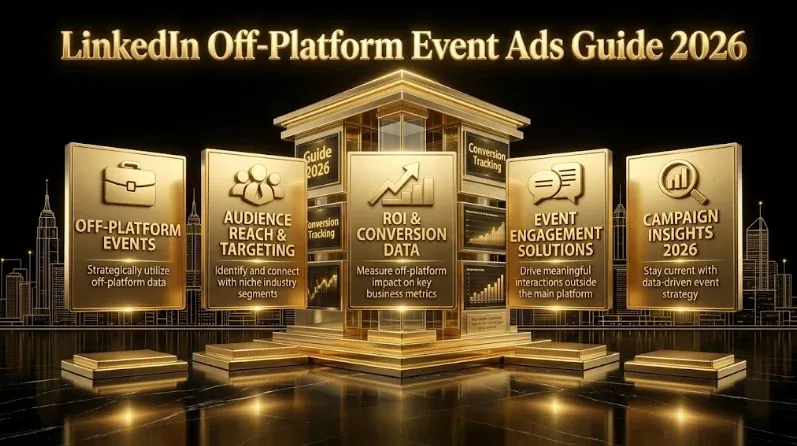
LinkedIn launched Off-Platform Event Ads in May 2026 — a new format that drives registrations to your own webinar page, event site, livestream, or registration form rather than keeping the entire flow inside LinkedIn. This solves the previous limitation where LinkedIn Event Ads forced all registrations through LinkedIn’s native registration flow (limiting CRM integration, custom form fields, and consent flow control). Off-Platform Event Ads matter for B2B because: (1) 62% of B2B marketers consider events a top full-funnel tactic, (2) registrations are high-intent actions (much stronger than content downloads), (3) marketers now control event stack, CRM sync, form fields, consent flow, and post-event follow-up. Best use cases: webinars, virtual workshops, roundtables, hybrid events, customer summits, product launches, partner events. The format is particularly powerful for B2B SaaS with long sales cycles where event-driven nurture compounds with paid retargeting.
Key Takeaways
- LinkedIn launched Off-Platform Event Ads in May 2026 — drives registrations to YOUR pages, not LinkedIn-native flow.
- Solves previous limitation: native LinkedIn Event Ads forced registrations through LinkedIn’s flow.
- 62% of B2B marketers consider events a top full-funnel tactic.
- Marketers control event stack, CRM sync, custom form fields, consent flow, and follow-up.
- Best for: webinars, virtual workshops, roundtables, hybrid events, customer summits, partner events.
- Event-driven nurture compounds with paid LinkedIn retargeting for long B2B cycles.
- Measure on attended (not just registered), pipeline progression post-event, and downstream SQL conversion.
What Changed in May 2026
LinkedIn historically offered Event Ads as a format — but with significant limitations:
Previous LinkedIn Event Ads (pre-May 2026):
- Registrations happened on LinkedIn’s native registration page
- Limited form field customization
- Registrant data flowed only to LinkedIn (no native CRM sync)
- Brand control was minimal
- Post-event follow-up required manual export
New Off-Platform Event Ads (May 2026+):
- Registrations happen on YOUR landing page
- Full form field customization (whatever your platform supports)
- Native CRM sync (HubSpot, Salesforce, Marketo, etc.)
- Complete brand control on registration page
- Automated post-event workflows possible
The change is meaningful because event-driven B2B marketing has historically required either staying inside LinkedIn (with limited control) or sending traffic to off-platform landing pages without the native Event Ad framing. Off-Platform Event Ads combine LinkedIn’s targeting + event framing with your owned page experience.
Why Events Matter So Much for B2B
Events are uniquely high-leverage for B2B:
1. Registrations indicate strong intent.
A webinar registration is a stronger intent signal than a content download. Registrants invest scheduled time — meaning they expect value. Content downloaders often just want the resource.
2. Event audiences become retargeting goldmines.
Registrants + attendees become valuable retargeting audiences for 30-90 days post-event. Cross-sell, upsell, follow-up campaigns to event audiences perform 40-60% better than cold acquisition.
3. Multi-touch attribution shows event influence.
Multi-touch attribution data shows events appear in 30-50% of B2B buyer journeys for high-ACV deals. Events aren’t only direct-response — they influence buyers across the journey.
4. 62% of B2B marketers consider events top full-funnel.
Per LinkedIn 2026 data, 62% of B2B marketers consider events among their top full-funnel tactics — only second to LinkedIn Ads themselves. The events + LinkedIn combination is recognized as best-in-class.
5. Event-driven sales conversations.
Events provide context for sales follow-up that cold outreach lacks. “I noticed you attended our webinar on [topic]…” opens conversations cold outreach can’t.
When to Use Off-Platform Event Ads
The new format unlocks specific B2B use cases:
Use Case 1: Webinars
Setup: Off-Platform Event Ad → your webinar registration page → CRM sync → calendar invite → reminder sequence → live event → post-event nurture
Why off-platform matters: Custom form fields capture qualifying information (company size, role, use case, current vendor) that LinkedIn-native registration can’t. CRM sync routes registrants to appropriate sales rep or nurture sequence.
Expected performance:
- Registration conversion: 12-20% (higher than typical content downloads)
- Attendance rate: 35-55% of registrants
- Attended → SQL: 5-15%
- Cost per registrant: $50-$150
- Cost per attendee: $100-$400
Use Case 2: Roundtables and Virtual Workshops
Setup: Off-Platform Event Ad → limited-attendance registration page → application screening → confirmed attendees → invite-only event → relationship-building follow-up
Why off-platform matters: Screening forms (application-style with qualifying questions) require custom field control. LinkedIn-native registration can’t filter for quality.
Expected performance:
- Application conversion: 4-8% (lower than open webinars; screened for quality)
- Approval rate (you set): 30-60% of applicants
- Attendance rate: 70-85% of approved (higher commitment)
- Attended → opportunity: 15-30% (high-intent audience)
- Cost per attendee: $300-$800
Use Case 3: Hybrid Field Events
Setup: Off-Platform Event Ad → field event registration page → city-specific events → in-person attendance → relationship-building
Why off-platform matters: City-specific event capacity, custom dietary/accessibility forms, in-person meeting scheduling tools — all impossible on LinkedIn native.
Expected performance:
- Registration conversion: 5-12% (city/date filtered)
- Attendance rate: 60-80% (people committed to physical attendance)
- Attended → opportunity: 20-40% (high-touch in-person engagement)
- Cost per attendee: $500-$2,000+ (event costs dominate)
Use Case 4: Customer Summits
Setup: Off-Platform Event Ad → existing customer + prospect registration → segmented experiences → relationship + expansion + sales motion
Why off-platform matters: Segmented registration paths (existing customer vs prospect) require custom logic. CRM enrichment based on existing data drives personalization.
Expected performance:
- Customer attendance: 30-50% of invited customers
- Prospect attendance: 8-20% of invited prospects
- Customer → expansion: 25-45% within 90 days
- Prospect → opportunity: 15-30% within 90 days
Use Case 5: Product Launch Events
Setup: Off-Platform Event Ad → product launch landing page → launch event → product trial signup → onboarding
Why off-platform matters: Launch event landing pages need to seamlessly transition to product signup. LinkedIn-native flow breaks this transition.
Expected performance:
- Registration → attendance: 40-60%
- Attended → trial signup: 25-45%
- Trial → paid conversion: 15-25% (standard PLG conversion)
Use Case 6: Partner Events
Setup: Off-Platform Event Ad → partner-co-branded registration → joint event → partnership-driven pipeline
Why off-platform matters: Partner co-branding requires custom landing page design. Joint CRM sync to both partner organizations is impossible on LinkedIn native.
Setting Up Off-Platform Event Ads
Step 1: Build registration infrastructure.
Requirements:
- Landing page (your CMS or event platform — Bizzabo, Goldcast, Splash, Hopin, etc.)
- Form integration with CRM (HubSpot, Salesforce, Marketo)
- Calendar invite system (auto-sends on registration)
- Reminder email sequence (24h, 1h before)
- Post-event follow-up workflow
Step 2: Define audience.
Use LinkedIn targeting:
- Tight ICP (10K-50K members for awareness; tighter for high-intent events)
- Matched Audience Company List (for ABM-tied events)
- Retargeting (past content engagers, website visitors)
Step 3: Build ad creative.
Required elements:
- Event title (compelling, specific)
- Date + time (specific, not vague)
- Speakers (names, titles, companies — credibility signals)
- Value prop (what attendees will learn/gain)
- CTA: “Register now”
Step 4: Configure Off-Platform Event Ad in Campaign Manager.
In Campaign Manager:
- New campaign → Objective: Website Conversions (or Lead Generation)
- Format: Off-Platform Event Ad (newly available)
- Destination: your registration page URL
- Conversion event: Registration completed
Step 5: Track conversions with LinkedIn CAPI.
Send these events back to LinkedIn:
- Registration complete (lead event)
- Attended (engagement event)
- Post-event SQL (qualified lead event)
This enables LinkedIn algorithm to optimize for actual attendees, not just registrants.
Measuring Off-Platform Event Ad Performance
Standard event metrics:
| Metric | Target |
|---|---|
| Cost per Registration | $50-$200 (varies by event quality) |
| Registration → Attendance rate | 35-55% for virtual events; 60-80% for in-person |
| Cost per Attendee | $100-$400 for virtual; $500-$2,000+ for in-person |
| Attended → MQL | 30-60% |
| MQL → SQL | 20-40% |
| SQL → Opportunity | 30-50% |
| Cost per Opportunity | $1,500-$8,000 typical |
| Pipeline contribution from event | 15-35% of pipeline within 90 days |
Critical: measure attendance, not just registrations. A 30% attendance rate dramatically changes the economics. Optimize for attendees (with reminders, calendar invites, “What to expect” emails) — not just registrants.
Event-Driven Nurture Compounding
The strongest B2B event programs use compounding nurture:
Pre-event (T-30 days to T-day):
- Registration drives via Off-Platform Event Ads
- Reminder emails (T-7, T-1, T-1h)
- “What you’ll learn” content series
- Speaker spotlight content
Event day:
- Live event with interactive Q&A
- Post-event survey
- Calendar booking option for sales conversations
- Resource download
Post-event (T+1 to T+30 days):
- Recording + slides to attendees
- Personalized follow-up based on engagement (attended live, partial attended, registered-not-attended)
- Sales BDR/AE outreach (sequenced over 2-3 weeks)
- Retargeting paid ads to event audience
Long-tail nurture (T+30 to T+180 days):
- Quarterly content drips
- Next event invitations
- Anniversary touch points
The compounding effect: a single event generates pipeline for 6-12 months, not just the days surrounding the event.
Common Off-Platform Event Ad Mistakes
Mistake 1: Measuring only registrations. Registrations are easy; attendance is hard. A 1,000-registrant webinar with 30% attendance = 300 attendees. Optimize for attendees through reminders + value prop reinforcement.
Mistake 2: No CRM integration on registration form. Registrants flow to a spreadsheet, not CRM. Sales can’t follow up systematically. Always sync registrations to CRM with full custom field capture.
Mistake 3: Same nurture for attendees + non-attendees. Attendees and non-attendees need different follow-up. Attendees: “Thanks for joining — here’s the recording and next steps.” Non-attendees: “Sorry you missed it — here’s what you missed + reschedule.” Different paths matter.
Mistake 4: One-off events without compounding nurture. Event happens, then nothing. 90% of event value is in post-event nurture. Build 180-day nurture sequences before promoting the event.
Mistake 5: Targeting too broadly. Cheap registrations from non-ICP audiences inflate registrant count but produce no pipeline. Tight ICP targeting (10K-30K members) outperforms broad targeting.
Mistake 6: Generic event content. “Top 10 marketing trends” is generic. “How to set up B2B SaaS Lead Scoring in HubSpot for $25K+ ACV products” is specific. Specific events attract specific (higher-intent) audiences.
Mistake 7: Missing retargeting from registrants. Registrants are valuable retargeting audiences for 60-90 days. Run retargeting campaigns specifically to event audiences.
Mistake 8: No sales coordination pre-event. Sales should know which prospects registered. Pre-event coordination prepares sales for high-intent follow-up.
How OLA Supports Off-Platform Event Ads
OLA’s optimization layer enhances event ad performance:
- CAPI integration — sends attendance + downstream conversion events back to LinkedIn for optimization
- Audience layering — combines event retargeting audiences with paid campaigns for compound effect
- Cost per attendee tracking — surfaces true event economics (not just registrant count)
- Pipeline contribution measurement — measures event impact on 90-day pipeline
- Refresh cadence — supports multi-event programs with rotating creative
Flat $29/month per Ad Account. 15-minute setup. Works for B2B SaaS teams running event-driven programs.
For teams that want senior operators managing event-led pipeline programs + cross-channel coordination + post-event nurture, GrowthSpree’s managed service wraps OLA into a $3,000/month flat engagement — month-to-month, HubSpot-native.
FAQs
What are LinkedIn Off-Platform Event Ads?
LinkedIn Off-Platform Event Ads launched in May 2026 — a new ad format that drives event registrations to YOUR landing page, event site, livestream, or registration form (rather than LinkedIn’s native registration flow). Previously, LinkedIn Event Ads forced all registrations through LinkedIn’s native page with limited customization. Off-Platform Event Ads give you control of: event stack, CRM sync, custom form fields, consent flow, and post-event follow-up.
When should I use Off-Platform Event Ads vs native LinkedIn Event Ads?
Use Off-Platform Event Ads when: you need custom form fields (qualifying questions, application-style screening), CRM sync is critical, brand control on registration page matters, complex post-event workflows are required. Use native LinkedIn Event Ads when: simple webinar registration is sufficient, your event platform doesn’t support custom integration, you prioritize simplicity over customization. For most B2B SaaS, Off-Platform is now the better choice for most events.
What B2B use cases work best for Off-Platform Event Ads?
6 strong use cases: (1) Webinars (broad reach, value-prop driven), (2) Roundtables and virtual workshops (screened, smaller, higher-intent), (3) Hybrid field events (city-specific, in-person component), (4) Customer summits (segmented customer + prospect experiences), (5) Product launch events (seamless transition to trial signup), (6) Partner events (co-branded with custom landing pages). Each use case has different conversion expectations and ROI economics.
What’s a good cost per registration for LinkedIn event ads?
LinkedIn event ad cost per registration ranges $50-$200 typically. Lower end ($50-$80) for broad-audience webinars with strong value props. Higher end ($120-$200) for narrow ICP targeting or premium content. For application-screened roundtables: $200-$400 per application (higher quality). For in-person field events: $300-$600 per registration (premium event costs justify). More important metric: cost per attendee, which is typically 2-3x cost per registration (because attendance rates are 35-55%).
How do I measure Off-Platform Event Ad ROI?
Measure attendance, not just registrations. Standard funnel: Registration ($50-$200 CPR) → Attendance (35-55%, $100-$400 cost per attendee) → MQL conversion (30-60% of attendees) → SQL (20-40%) → Opportunity (30-50%) → Closed-Won (varies). Pipeline contribution from event: 15-35% of pipeline within 90 days. Critical: implement CAPI to send attendance + downstream events back to LinkedIn for algorithm optimization.
What’s the registration → attendance rate for LinkedIn events?
Virtual events: 35-55% registration → attendance rate (typical). In-person events: 60-80% (higher commitment). Application-screened roundtables: 70-85% (highest commitment). To improve attendance: implement strong reminder cadence (T-7, T-1, T-1h emails), calendar invites at registration, “What to expect” content series, last-day reminders with content highlights. Reminders alone can improve attendance 15-25%.
How do I integrate Off-Platform Event Ads with CRM?
Standard integration pattern: (1) Registration form on your landing page → fields sync to CRM (HubSpot, Salesforce, Marketo) via native integration or webhook, (2) CAPI sends “Registration” event to LinkedIn, (3) Calendar invite + reminder emails triggered, (4) Post-event: attendance status synced to CRM, (5) Sales BDR/AE outreach triggered for attendees with appropriate scoring, (6) Retargeting audiences built from registrants + attendees in LinkedIn Matched Audiences.
What’s event-driven nurture compounding?
Event-driven nurture compounding is the long-tail pipeline impact from a single event. Pattern: pre-event (registration + reminders) → event day (live attendance) → post-event T+1 to T+30 (recording, personalized follow-up, sales outreach, retargeting) → long-tail T+30 to T+180 (quarterly drips, next event invitations, anniversary touches). Result: single events generate pipeline for 6-12 months, not just event days. 90% of event value is in post-event nurture, not the event itself.
Run Your First Off-Platform Event Ad Campaign
Connect OLA + your event platform + HubSpot. The dashboard tracks cost per registration, cost per attendee, attendance rate, and pipeline contribution from event audiences. Most B2B SaaS discover event-driven pipeline contribution is 2-3x higher than they previously measured.
More Featured Blogs
View All Blogs
How to Use AI for LinkedIn Audience & ICP Research


LinkedIn Ads Account Structure & Naming Convention for B2B SaaS
AI vs Human LinkedIn Ad Copy: Which Wins?