Quick Summary
Summarize this article instantly with your preferred AI model.
LinkedIn Lead Gen Forms vs Landing Pages: Conversion Rate vs SQL Rate Decision Framework (2026)
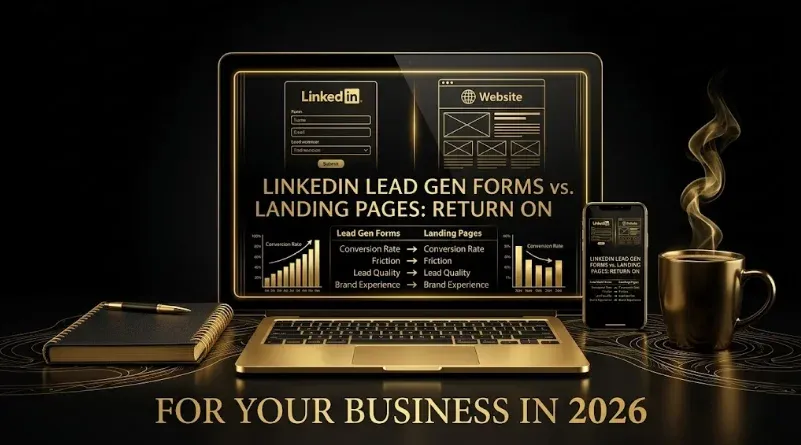
LinkedIn Lead Gen Forms convert at 13% — about 3-4x the 2-4% rate of traditional landing pages. But SQL rates often favor landing pages by 20-40%, because form friction filters non-ICP traffic. For B2B SaaS, the decision isn’t either-or: use Lead Gen Forms for top-of-funnel content offers (whitepapers, reports, webinars) and landing pages for bottom-of-funnel offers (demos, trials, pricing). The cost per SQL is the only metric that matters — and it usually favors landing pages for high-ACV products.
Key Takeaways
- LinkedIn Lead Gen Forms (LGF) convert at 8-15% (median 13%). Landing pages convert at 2-5% (median 4%). LGF is roughly 3x higher.
- Cost per lead via LGF averages $45-$130. Landing pages average $150-$250+. LGF reduces CPL by 25-35%.
- SQL conversion rates often favor landing pages by 20-40% — form friction acts as a quality filter.
- For B2B SaaS with ACV above $25K, landing pages typically produce lower cost per SQL despite higher CPL.
- The hybrid model wins: use LGF for TOFU/MOFU content offers, landing pages for BOFU demo/trial requests.
- HubSpot integration matters more than format choice — Lead Gen Form leads need the same CRM treatment as landing page leads to be measurable.
The Headline Numbers (And What They Hide)
Every benchmark report cites the same two numbers:
- Lead Gen Forms: 13% average conversion rate
- Landing pages: 4% average conversion rate
This is the most-cited stat in LinkedIn Ads content. It’s also the most misleading. The 3x conversion advantage looks definitive — but it doesn’t tell you which format produces more revenue.
Here’s the reframe: conversion rate measures how many people fill a form. Cost per SQL measures how many of those form fillers actually become qualified buyers. Lead Gen Forms win on the first metric. Landing pages often win on the second.
For B2B SaaS, the gap between these two metrics is the entire game.
The Mechanics: Why Each Format Performs the Way It Does
Lead Gen Forms open natively inside LinkedIn when a user clicks the ad. Profile data (name, email, company, job title) is pre-filled from the LinkedIn account. The user reviews, hits submit, done. No off-platform redirect, no page load, no second-thought delay.
The 13% conversion rate reflects this near-zero friction. Mobile users especially love LGF — no 4G page load, no mobile form typing, no distraction.
Landing pages require the user to leave LinkedIn, wait for the page to load, read additional context, and manually fill (or auto-fill from a saved browser profile) a form on your domain.
Every additional step reduces conversion rate. Landing pages convert at 2-5% because each step (page load, scroll, form, submit) bleeds users. But each step also filters — by the time someone fills a landing page form, they’ve read your hero, scanned proof points, and decided to engage.
This filtering is why landing pages produce 20-40% higher SQL conversion rates than LGF, even though raw conversion is dramatically lower.
The Comparison Table
| Metric | Lead Gen Forms | Landing Pages |
|---|---|---|
| Conversion Rate (median) | 13% (range 8-15%) | 4% (range 2-5%) |
| Cost per Lead (median) | $45-$130 | $150-$250+ |
| MQL → SQL Conversion | 8-15% | 15-25% |
| Cost per SQL | $300-$900 | $600-$1,500 |
| Mobile Performance | Excellent (native) | Variable (load times, friction) |
| Setup Complexity | Low (Campaign Manager) | High (page design, dev, A/B testing) |
| Lead Quality Signal | Low (instant submit) | High (engagement before submit) |
| Retargeting Audience Building | Limited (LinkedIn only) | Strong (cookies, pixels, multi-channel) |
| Pre-fill from LinkedIn Profile | Yes (automatic) | No (manual entry only) |
| CRM Integration | Native HubSpot/Salesforce sync | Requires custom form integration |
| Best Funnel Stage | TOFU / MOFU | MOFU / BOFU |
| Best Offer Type | Content (whitepapers, reports, webinars) | High-commitment (demos, trials, pricing) |
The cost per SQL row is the one that matters. LGF often wins; landing pages sometimes do — depending on ACV, ICP precision, and how aggressive your offer is.
When to Use Lead Gen Forms
Lead Gen Forms win when:
1. The offer is low-commitment content. Whitepapers, gated reports, ebooks, webinar registrations, newsletter sign-ups. These are content offers where the user trades minimal info for educational material. LGF’s frictionless flow is perfect.
2. You need volume for the LinkedIn algorithm. Below 30 conversions per month, LinkedIn’s optimization algorithm can’t learn effectively. LGF’s higher conversion rate gets you to learning-phase volume faster.
3. Mobile traffic dominates your audience. Mobile landing page conversion is brutal — slow 4G loads, awkward typing, accidental scroll-aways. LGF’s native mobile experience converts 2-3x better on mobile than equivalent landing pages.
4. Geographic markets with mobile-first LinkedIn use (India, Southeast Asia, parts of Latin America). LGF dominates landing pages here by a wider margin than in US/EU markets.
5. ABM warming sequences. Use LGF for top-of-funnel content amplification to target accounts. The leads feed retargeting audiences and CRM nurture flows even if they’re not sales-ready immediately.
When to Use Landing Pages
Landing pages win when:
1. The offer is high-commitment. Demo requests, free trial sign-ups, pricing conversations, consultation bookings. These need the buyer to be ready, not just curious. Landing pages filter out the curious-but-not-ready segment.
2. You’re optimizing for SQL quality, not lead volume. A 4% landing page conversion that produces 25% MQL-to-SQL is mathematically better than a 13% LGF conversion that produces 8% MQL-to-SQL for high-ACV products.
3. You need to build retargeting audiences. Landing page visits populate your pixel-based retargeting pools (LinkedIn Insight Tag, Google Analytics, Meta Pixel). Lead Gen Form submitters never visit your site — you can’t retarget them outside LinkedIn.
4. You need to explain complex value. Cybersecurity, fintech, healthcare IT, and other complex categories often need 5-10 paragraphs of context before a buyer can make a meaningful decision. Landing pages enable this. Lead Gen Forms do not.
5. ACV is above $25K. At higher contract values, lead quality matters more than lead volume. The math: a $200 landing page CPL producing 25% SQL conversion = $800 cost per SQL. A $90 LGF CPL producing 10% SQL conversion = $900 cost per SQL. Same cost per SQL, but landing page leads progress further down the funnel.
The Hybrid Model (What Top-Performing B2B SaaS Teams Use)
The strongest LinkedIn programs don’t pick one. They run both, mapped to funnel stage:
TOFU campaigns (50-60% of budget):
- Lead Gen Forms for content offers
- Goal: build retargeting audiences, populate CRM, identify in-market accounts
- Acceptable cost per SQL is high because these leads are early-stage
MOFU campaigns (25-35% of budget):
- Lead Gen Forms for assessments, calculators, mid-commitment offers
- Some landing pages for case study downloads and product overviews
- Goal: nurture warm audiences toward demo-ready intent
BOFU campaigns (10-20% of budget):
- Landing pages exclusively for demos, trials, pricing
- Goal: high-intent SQLs ready for sales conversation
- Cost per SQL needs to be tight here because volume is lower
This split typically produces blended cost per SQL 30-40% lower than either format running solo.
The format isn’t the decision. The funnel stage is.
What Most B2B SaaS Teams Get Wrong
Mistake 1: Using LGF for demo requests. Demo conversion through LGF looks high because the form is easy. But 50-70% of LGF demo leads ghost the sales follow-up because they didn’t really mean it — they just clicked. Landing pages filter this out.
Mistake 2: Running landing pages without proper attribution. Landing page traffic gets attributed to “organic” or “direct” in CRM if UTMs aren’t configured correctly. LinkedIn loses credit for the awareness work. Always pass utm_source=linkedin, utm_medium=cpc, and utm_campaign={CampaignName} parameters.
Mistake 3: Optimizing LGF on form completion rate, not SQL conversion rate. A 15% LGF completion rate looks great but means nothing if SQL conversion is 5%. Always track downstream conversion rates by form type.
Mistake 4: Not syncing LGF leads into HubSpot in real-time. LinkedIn’s native HubSpot integration syncs Lead Gen Form leads automatically, but field mapping and lifecycle stage triggers need explicit configuration. Without this, LGF leads sit in CRM with no source attribution.
Mistake 5: Failing to A/B test offer copy on both formats. Top-performing teams run the same offer through both LGF and landing page simultaneously for 4-6 weeks, then pick the format with the lower cost per SQL — not the higher conversion rate.
How HubSpot Sync Works for Both Formats
Both Lead Gen Forms and landing page submissions can flow into HubSpot, but the integration patterns differ:
Lead Gen Forms (native):
- HubSpot’s native LinkedIn integration auto-syncs form submissions as new contacts
- Field mapping from LinkedIn → HubSpot is configurable in the integration settings
- Original source = “Paid Social”, Source Drill-Down 1 = “LinkedIn”
- Pre-fill data from LinkedIn profile populates company, job title, seniority
Landing pages:
- Forms built on HubSpot landing pages or HubSpot form embeds flow into CRM directly
- Forms on custom pages need API integration or webhook routing to HubSpot
- UTM parameters must be passed and captured into contact properties
- Original source still needs to be set to “Paid Social” via workflow
Once both formats are flowing into HubSpot, the unified view shows conversion by source: LGF vs landing page CPL, MQL rate, SQL rate, and ultimately cost per SQL.
How OLA Closes the Reporting Loop
OLA connects LinkedIn Campaign Manager and HubSpot, then reports cost per SQL by ad format and by lead source. The dashboard surfaces:
- LGF vs landing page CPL comparison per campaign
- Downstream conversion rates (MQL %, SQL %, opportunity %, closed-won %) by form type
- Cost per SQL by format, broken down by audience and campaign
- Recommendations on which campaigns to flip between LGF and landing pages based on actual SQL data
Flat $29/month. 15-minute OAuth setup. Works for B2B SaaS teams on HubSpot running $5K–$100K/month in LinkedIn spend.
For teams that want senior operators running the full optimization including landing page design and creative refresh, GrowthSpree’s managed service wraps OLA into a $3,000/month flat engagement — month-to-month, HubSpot-native.
FAQs
What’s the conversion rate for LinkedIn Lead Gen Forms?
LinkedIn Lead Gen Forms convert at 8-15% on average, with a median of 13%. The conversion advantage comes from native pre-filled forms (using LinkedIn profile data) and zero off-platform friction. Top quartile performance hits 15-20% with optimized form fields and tight targeting.
What’s the conversion rate for landing pages from LinkedIn Ads?
Landing pages from LinkedIn Ads convert at 2-5% on average, with a median of 4%. The lower rate reflects added friction (page load, additional reading, manual form completion) but produces higher-intent leads who’ve engaged with your content before submitting.
Which is better for B2B SaaS — Lead Gen Forms or landing pages?
Both. For top-of-funnel content offers (whitepapers, reports, webinars), use Lead Gen Forms — they convert 3x higher and reduce CPL by 25-35%. For bottom-of-funnel offers (demos, trials, pricing), use landing pages — they produce 20-40% higher SQL conversion rates. The strongest B2B SaaS programs run both, mapped to funnel stage.
Do Lead Gen Forms produce lower-quality leads?
Yes, on average. LGF’s frictionless submit flow captures leads at lower intent thresholds than landing page submissions. SQL conversion rates from LGF are typically 8-15%, vs 15-25% for landing pages. For high-ACV products, this difference matters more than the headline CPL gap.
How much do LinkedIn Lead Gen Forms cost?
Lead Gen Form CPL averages $45-$130, with a median around $75-$110 for B2B campaigns. Compare to landing page CPL of $150-$250+. LGF reduces CPL by 25-35% across most B2B SaaS verticals. Cost per SQL however often favors landing pages due to higher downstream conversion quality.
Can I retarget people who submit Lead Gen Forms?
Yes, but only within LinkedIn — using LinkedIn’s matched audiences feature to upload your CRM list. You cannot retarget LGF submitters across Google, Meta, or display networks because they never visited your site (no cookie or pixel fired). For multi-channel retargeting, landing page traffic is required.
Should I sync Lead Gen Form leads to HubSpot in real-time?
Yes — HubSpot’s native LinkedIn integration handles this automatically once connected via OAuth. Configure field mapping (LinkedIn fields → HubSpot contact properties) and lifecycle stage triggers (auto-assign Lead Gen Form leads as “Lead” stage). Without real-time sync, LGF leads sit in CRM with no source attribution and miss sales follow-up windows.
Why do landing pages produce higher SQL rates?
Form friction acts as an intent filter. A user who clicks an ad, reads a landing page hero, scrolls to case studies, and then submits has demonstrated significantly higher buying intent than someone who clicks LGF and submits in 5 seconds. The 20-40% higher SQL conversion rate on landing page leads reflects this engagement gap.
See Cost per SQL by Format for Your Account
Connect OLA to LinkedIn and HubSpot. See exactly how Lead Gen Forms vs landing pages perform on cost per SQL — not just conversion rate. Most teams discover they’re running 60-70% of budget through the wrong format for their stage.
More Featured Blogs
View All Blogs
LinkedIn Ad Character Limits: The Reference for Every Format



LinkedIn Conversions API: What It Is and How to Set It Up
LinkedIn Ads Billing: How You Get Charged and How to Control It