Quick Summary
Summarize this article instantly with your preferred AI model.
LinkedIn Conversation Ads: What They Are and How to Use Them
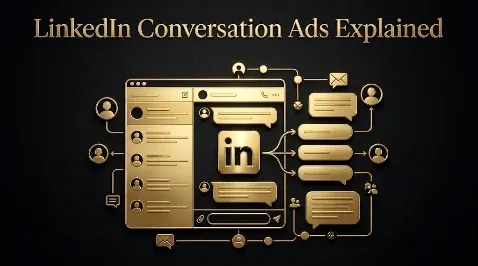
LinkedIn Conversation Ads: What They Are and How to Use Them
LinkedIn Conversation Ads are interactive, choose-your-own-path messages that land in a member’s inbox under a real person’s name, with several call-to-action buttons that let the buyer pick where the conversation goes next. They are part of LinkedIn’s sponsored messaging, alongside the simpler single-message Message Ads, and sponsored messaging earns eye-catching open rates, often cited around 50% to 60%. But two things keep that from being the whole story. First, an open is not a lead, and cost per lead on these ads often runs into the hundreds. Second, controlled head-to-head tests suggest Conversation Ads currently open lower than plain Message Ads, so the interactive format is not automatically the better buy. They also cannot be delivered to members in the European Union. This guide covers what they are, how they compare to Message Ads, their specs and costs, how to build a flow, and how to measure them on pipeline rather than opens.
Key takeaways
- Conversation Ads are interactive inbox messages with multiple CTA buttons that let the buyer choose a path; Message Ads are the simpler one-message, one-CTA version.
- Sponsored messaging earns high open rates, often cited at 50% to 60%, but head-to-head tests suggest Conversation Ads now open lower than Message Ads, around 35% versus 50% to 55%.
- You pay per send, roughly $0.50 to $3.00, so a low cost per send can still mean a high cost per lead, often $150 or more.
- Sponsored messaging cannot be delivered to members in the European Union, so a largely European audience rules this format out.
- Treat them as a warm, high-intent format, test them head-to-head against Message Ads, and judge both on cost per qualified lead, not open rate.
What are LinkedIn Conversation Ads?
Conversation Ads are a sponsored messaging format that delivers an interactive message to a member’s LinkedIn inbox. Instead of a static ad in the feed, the member gets a message that appears to come from a real person at your company, with a short opening line and a set of buttons offering different next steps, such as reading a case study, seeing pricing, booking a demo, or simply browsing. Each button leads somewhere different, so the ad behaves like a branching conversation rather than a single pitch. That is the whole idea: the buyer self-selects the path that fits where they are, and you route each path to the right destination. Because it sits in the inbox under a person’s name, it earns far more attention than a feed ad, which is both its strength and the reason it has to be genuinely relevant, or it reads as spam.
Conversation Ads versus Message Ads
Both are sponsored messaging, but they do different jobs, and the choice matters more than it looks.
| Message Ads | Conversation Ads | |
|---|---|---|
| Structure | One message, one call to action | Opening message plus up to about five CTA branches |
| Best for | Broad, high-volume outreach and one clear ask | Complex, multi-stakeholder buys and self-selected paths |
| Typical use | Content downloads, event sign-ups, re-engagement | ABM, demo and trial requests, pre-sales qualification |
| Feel | Talks to people | Converses with people |
The short version is that Message Ads talk to people and Conversation Ads speak with them. If you have one clear offer and a broad audience, a Message Ad is simpler and cheaper to run. If your buyers are at different stages, or you want to let them sort themselves by intent for a considered, multi-stakeholder purchase, Conversation Ads earn their extra complexity. But do not assume the interactive format wins, because the data below complicates that.
Do Conversation Ads still beat Message Ads?
Not always, and recently often not. Benchmark roundups cite high sponsored-messaging open rates of 50% to 60%, but careful head-to-head tests, same targeting, same creative, have found Conversation Ads opening around 35% while Message Ads open closer to 50% to 55%. Because fewer opens cascade into fewer clicks and fewer conversions, those tests report roughly 40% higher cost per lead on Conversation Ads for the same spend. LinkedIn has not confirmed a cause, and theories range from inbox routing to message priority, so treat this as a current, unexplained pattern rather than a permanent rule. The practical takeaway is the honest one: do not assume the interactive, multi-button format automatically outperforms a simple Message Ad. Run them head-to-head on your own audience, watch cost per qualified lead, and be willing to fall back to Message Ads if the opens are not there, since Conversation Ads’ main unique advantage is retargeting the people who engage with them.
How much do Conversation Ads cost?
You pay per send, not per impression or click, which changes how you read the economics. Here are the typical numbers, drawn from 2025 benchmark sets; treat them as directional.
| Metric | Typical | What to know |
|---|---|---|
| Open rate | 50% to 60% for sponsored messaging; lower for Conversation Ads in recent tests | Opens are easy, pipeline is not |
| Click-through rate | 2% to 5%, with top performers at 8% to 10% | Far above the feed’s 0.3% to 0.5% |
| Cost per send | $0.50 to $3.00, often $0.75 to $1.50 | C-suite, US and UK audiences, and Q4 cost more |
| Cost per lead | commonly $150 or more | A cheap cost per send still adds up |
The thing to notice is how a cheap cost per send turns into an expensive cost per lead. If you pay $1.00 per send and 3% of recipients click, your cost per click is already above $30, and only a fraction of those clicks become leads. So the open rate that looks spectacular in the dashboard is not the number that matters.
How do you build a conversation flow?
The flow is the ad, so design it deliberately and mind the specs. The opening message can run up to 500 characters and should use personalization like the member’s first name, and because it comes from a person, it should sound like one. Offer up to about five distinct buttons, each with short button text leading to a different branch, for example “see how it works,” “read a customer story,” “talk to sales,” and “just browsing.” Each button can lead to a follow-up message, a lead gen form, or a landing page, and a campaign supports up to around five conversation paths. You can add an optional banner image, which shows on desktop at 300 by 250 pixels in a standard image file type, though it does not always display, so never put essential information only in the banner. Keep the flow to two or three levels deep, because every extra step sheds people, and always include a graceful “not interested” exit. Before launch, preview on desktop and mobile, test every link, and set up conversion tracking, because without it you will only ever see opens and clicks, never outcomes.
Open, Branch, Qualify
The way to make Conversation Ads pay off is a three-step logic we call Open, Branch, Qualify. Open: earn the open with a relevant audience and a human, specific opening line, since the inbox placement only helps if the message deserves to be there. Branch: design the buttons to sort people by intent, so the person ready for a demo and the person just learning both find their natural next step, and you can tell them apart. Qualify: send the high-intent branches to a lead form or a booking page, track the conversion, and judge the campaign on the qualified leads those branches produce, not on the headline open rate. Open earns attention, the branches sort intent, and only the qualifying step tells you whether the spend worked.
Where Conversation Ads work, and the EU restriction
Conversation Ads fit warm, high-intent situations more than cold, broad ones: inviting target accounts to an event or webinar, re-engaging people who already know you, driving demo bookings from a defined list, and guiding multi-stakeholder buying groups to the right resource. They are a poor fit for cheap, top-of-funnel volume, where a simple Message Ad is usually cheaper and, lately, opens better. There is also a hard constraint to know before you plan anything: sponsored messaging, both Message and Conversation Ads, cannot be delivered to members located in the European Union, so if your audience is largely European, this format is simply not available to you. LinkedIn has also been evolving its messaging formats over time, so confirm the current options and availability in Campaign Manager before you build a campaign around them.
How to measure Conversation Ads
Measure them on outcomes, and watch one reporting quirk. The outcomes that matter are the conversions on your high-intent branches, the qualified leads they produce, and the cost per qualified lead, not the open rate or the raw click count, both of which flatter the format. In Campaign Manager, read these ads in the Sponsored Messaging column view, because there is a trap: outside that view, LinkedIn reports sends as impressions and opens as clicks, so a Conversation Ad looks like it has a wild click-through rate when you are really seeing opens. Use the Sponsored Messaging view for sends, opens, open rate, and cost per send, your conversion tracking for what happened after the click, and the full reporting view to tie it to pipeline. Then compare it honestly against a Message Ad running the same offer.
Common Conversation Ads mistakes
The mistakes mostly come from treating the format like a feed ad or assuming interactivity wins. Judging it on the open rate, and concluding it is a runaway success while cost per qualified lead quietly climbs, is the big one. Assuming Conversation Ads beat Message Ads without testing, when recent head-to-head data often says the opposite, wastes budget on the more expensive format. Running it to a cold, broad audience, where a personal inbox message feels intrusive and converts poorly, misuses the format’s strength. Building a flow that is all roads to “book a demo,” with no path for someone who is just learning, drives people to the exit. And forgetting the EU restriction, so you build a plan for an audience the format cannot reach, wastes the whole effort.
High opens, but judge on pipeline
Here is the thread. Conversation Ads earn attention a feed ad cannot, but attention is not pipeline, and at a few dollars per send the cost per qualified lead can climb fast, especially since recent tests show them opening below plain Message Ads. Use them where warm, high-intent attention is worth paying for, design the flow to sort people by intent, read them in the Sponsored Messaging view, and always test them head-to-head against a Message Ad running the same offer. Then judge both on the cost per qualified lead and the pipeline your reporting confirms, not the click-through rate that looks so good in the inbox. If you want your LinkedIn messaging built around warm accounts and measured on pipeline, you can book a demo.
Frequently Asked Questions
Q1. What are LinkedIn Conversation Ads?
Conversation Ads are an interactive sponsored messaging format that delivers a message to a member’s LinkedIn inbox under a real person’s name, with several call-to-action buttons that let the buyer choose the next step, such as reading a case study, seeing pricing, or booking a demo. Each button leads to a different message, lead form, or landing page, so the ad behaves like a branching conversation rather than a single pitch. They earn high open rates because they sit in the inbox.
Q2. What is the difference between Conversation Ads and Message Ads?
Message Ads are a single message with one call to action, best for broad outreach and one clear ask like a content download or event sign-up. Conversation Ads add multiple CTA buttons and branches, so the buyer can choose their own path, which suits complex, multi-stakeholder journeys, ABM, and demo requests. Both are sponsored messaging, priced per send. The short version is that Message Ads talk to people and Conversation Ads speak with them.
Q3. Are Conversation Ads better than Message Ads?
Not automatically, and recently often not. Benchmark roundups cite high sponsored-messaging open rates, but head-to-head tests with the same targeting have found Conversation Ads opening around 35% versus 50% to 55% for Message Ads, which drives roughly 40% higher cost per lead. LinkedIn has not confirmed a cause. So test them head-to-head on your own audience, judge on cost per qualified lead, and use Conversation Ads mainly where their branching and engagement retargeting genuinely help.
Q4. How much do LinkedIn Conversation Ads cost?
You pay per send, typically $0.50 to $3.00, and often $0.75 to $1.50, with C-suite targeting, US and UK audiences, and the fourth quarter costing more. The catch is that a low cost per send can still mean a high cost per lead, often $150 or more, because only a fraction of recipients click and only a fraction of those convert. Judge the format on cost per qualified lead, not the low cost per send.
Q5. Can you run LinkedIn Conversation Ads in the EU?
No. Sponsored messaging, both Message Ads and Conversation Ads, cannot be delivered to members located in the European Union, so if your target audience is largely European, this format is not available to you. Plan around that before building a campaign. LinkedIn has also been changing its messaging formats over time, so confirm the current availability and naming in Campaign Manager rather than assuming what worked before still applies.
Q6. How do you build a Conversation Ad flow?
Write an opening message of up to 500 characters that sounds like a real person and uses personalization like the first name, then offer up to about five distinct buttons, each with short text leading to a follow-up message, a lead form, or a landing page. You can add an optional desktop banner image at 300 by 250 pixels, but it may not display, so keep essentials out of it. Keep the flow two or three levels deep, include a “not interested” exit, and set up conversion tracking before launch.
Q7. How do you measure Conversation Ads in Campaign Manager?
Use the Sponsored Messaging column view, because outside it LinkedIn reports sends as impressions and opens as clicks, which makes the numbers misleading. In that view you see sends, opens, open rate, click-to-open rate, and cost per send. For outcomes, rely on your conversion tracking to see which branches produced leads, and judge the campaign on cost per qualified lead and the pipeline your CRM confirms, not on opens.
Q8. When should you use Conversation Ads instead of Message Ads?
Use Conversation Ads for warm, high-intent, multi-stakeholder situations where letting buyers choose a path adds value: ABM to known accounts, demo and trial requests, and pre-sales qualification, plus when you want to retarget people who engage. Use Message Ads for broad, high-volume outreach, content downloads, event sign-ups, and re-engagement, where their simplicity and currently higher open rates make them more efficient. Either way, test the two head-to-head and let cost per qualified lead decide.
More Featured Blogs
View All Blogs
LinkedIn Ads Reporting: How to Read Campaign Manager


LinkedIn Ads Conversion Rate Benchmarks: What Is Good?
LinkedIn Ads and Marketo: How to Connect Them and Why