Quick Summary
Summarize this article instantly with your preferred AI model.
LinkedIn Campaign Objectives: Which One to Choose for B2B SaaS (2026 Decision Framework)
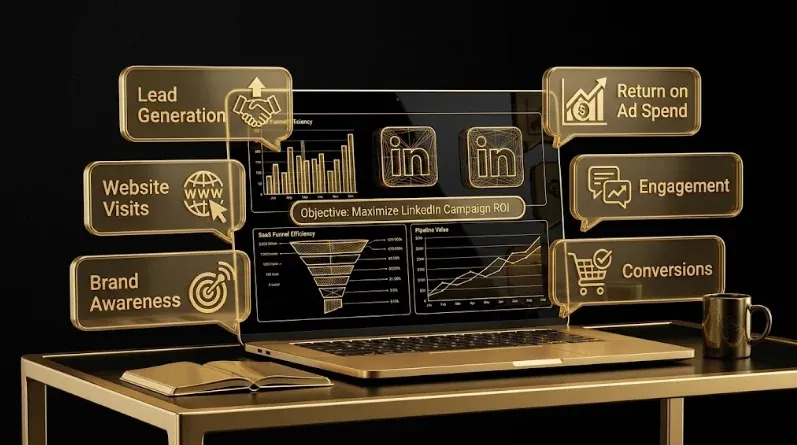
LinkedIn offers 6 campaign objectives: Brand Awareness, Website Visits, Engagement, Video Views, Lead Generation, and Website Conversions. For B2B SaaS, the choice between Lead Generation and Website Conversions matters most — Lead Generation uses native Lead Gen Forms (13% conversion rate) and is best for top-of-funnel content offers; Website Conversions sends traffic to your site and is best for bottom-of-funnel demo and trial requests. Use Brand Awareness only for TOFU reach campaigns. The right objective drops cost per SQL by 30-50% vs the wrong one.
Key Takeaways
- LinkedIn’s 6 campaign objectives are: Brand Awareness, Website Visits, Engagement, Video Views, Lead Generation, and Website Conversions.
- Lead Generation uses native Lead Gen Forms (13% conversion rate vs 4% landing pages) — best for top-of-funnel content offers.
- Website Conversions drives traffic to your site for on-page conversion — best for bottom-of-funnel demos, trials, and pricing requests when paired with CAPI.
- Brand Awareness optimizes for impressions only, not clicks or conversions — best for pure reach campaigns and Thought Leader Ads amplification.
- Picking the wrong objective inflates cost per SQL by 30-50% even with identical creative and audience.
- For B2B SaaS, the typical objective allocation: 20% Brand Awareness (TOFU), 30% Lead Generation (MOFU), 40% Website Conversions (BOFU), 10% Engagement/Video.
The 6 Objectives at a Glance
LinkedIn’s campaign objectives sit in three tiers — Awareness, Consideration, and Conversion — and each one optimizes for a different signal. Choosing wrong wastes budget no matter how good your audience and creative are.
| Objective | Tier | Optimizes For | Best For | Cost per SQL Impact |
|---|---|---|---|---|
| Brand Awareness | Awareness | Impressions to your audience | TOFU reach, Thought Leader Ads | Highest cost per SQL — but not the goal |
| Website Visits | Consideration | Clicks to your website | Mid-funnel traffic, content nurture | Medium |
| Engagement | Consideration | Likes, comments, shares, follows | Building organic + Company Page audience | Medium-high |
| Video Views | Consideration | Video plays (paid by view) | Cheaper video reach, retargeting source | Medium-high |
| Lead Generation | Conversion | Native form submissions | TOFU/MOFU gated content offers | Low (for content offers) |
| Website Conversions | Conversion | On-site conversions (when paired with CAPI) | BOFU demos, trials, pricing | Lowest — when set up correctly |
The two objectives B2B SaaS teams should use most are Lead Generation and Website Conversions. The decision between them is the single most impactful campaign setup choice you’ll make.
Lead Generation vs Website Conversions: The Real Decision
These two objectives produce dramatically different outcomes — even with the same audience, same creative, and same offer.
Lead Generation uses LinkedIn’s native Lead Gen Forms. The form opens inside LinkedIn when a user clicks the ad. Profile data (name, email, company, job title) is pre-filled. Submit happens in one click. No off-platform redirect.
Website Conversions sends the user to your site. They land on a page, scroll, read, and complete your own form. LinkedIn tracks the conversion via the Insight Tag or — better — LinkedIn’s Conversions API (CAPI) connected to your CRM.
The choice depends entirely on what you’re optimizing for:
| Factor | Lead Generation Wins | Website Conversions Wins |
|---|---|---|
| Form fill volume | Yes (3x higher conversion rate) | No |
| Cost per Lead | Yes (25-35% lower CPL) | No |
| SQL quality | No (form-fillers, not buyers) | Yes (20-40% higher SQL rate) |
| Cost per SQL (BOFU) | No | Yes (when paired with CAPI) |
| Retargeting audience building | No (LinkedIn-only) | Yes (site pixel + multi-channel) |
| Algorithm learning | Optimizes for form fills | Optimizes for actual pipeline events (with CAPI) |
| Mobile experience | Excellent (native) | Variable (landing page friction) |
| Best funnel stage | TOFU/MOFU content offers | BOFU demos, trials, pricing |
The rule of thumb: content offers → Lead Generation. Demo/trial/pricing → Website Conversions with CAPI.
A simpler version: if your goal is to put a person into a lead nurture flow, use Lead Generation. If your goal is to put a person into a sales conversation, use Website Conversions.
When to Use Brand Awareness
Brand Awareness optimizes purely for impressions. LinkedIn delivers your ad to the maximum number of people in your audience within your budget — without optimizing for clicks, conversions, or any downstream action.
Use Brand Awareness when:
- You’re running Thought Leader Ads to amplify executive or employee organic content. TLAs work best with Brand Awareness because the goal is reach, not direct response.
- You need to fill your retargeting funnel with cheap impressions. Brand Awareness produces the lowest CPM and feeds your retargeting audiences faster.
- You’re entering a new market or vertical. Awareness campaigns build category familiarity before direct-response works.
- You’re amplifying organic content for SEO benefit. LinkedIn Sponsored Articles run with Brand Awareness optimize for reach to drive organic engagement.
Don’t use Brand Awareness when:
- You need leads in your CRM. Brand Awareness doesn’t optimize for click-through or form fill.
- You’re running gated content offers. Use Lead Generation instead.
- You’re measuring on cost per SQL. Brand Awareness produces high CPL when you check it — but that’s not the goal.
When to Use Video Views
Video Views optimizes for video plays — you pay per view rather than per impression. Best for:
- Building a video viewer audience for retargeting. Once you have 97% completion viewers, retargeting them with conversion offers is the highest-ROI play in B2B SaaS.
- Educational content at scale. When the message requires explanation (product demos, founder stories, case study deep-dives), video outperforms static.
- Lower-CPM reach. Video Views often produces 20-30% lower CPM than Brand Awareness for the same audience.
Don’t use Video Views as your primary lead gen objective. Video viewers won’t convert directly at meaningful rates — they need to be retargeted with a follow-up direct-response offer.
When to Use Engagement
Engagement optimizes for likes, comments, shares, follows, and clicks. Best for:
- Growing your LinkedIn Company Page audience. Engagement campaigns surface your ads to people likely to interact, building organic followers.
- Amplifying community-driven content. When the post is conversational rather than promotional, Engagement objective lets it compound through social signals.
- Building engagement-based retargeting audiences. Ad engagers become a retargetable audience once they comment, share, or like.
Limited direct-response value. Use sparingly as a small budget allocation (5-10%) within your full-funnel mix.
The Full-Funnel Objective Allocation
For most growth-stage B2B SaaS running LinkedIn properly:
| Funnel Stage | % of Budget | Objective | Goal |
|---|---|---|---|
| TOFU — Awareness | 15-25% | Brand Awareness, Video Views | Build category familiarity, fill retargeting funnel |
| TOFU/MOFU — Content | 25-35% | Lead Generation | Capture content offers (reports, guides, webinars) |
| MOFU — Consideration | 10-20% | Website Visits, Engagement | Drive site traffic, build engagement audiences |
| BOFU — Conversion | 30-40% | Website Conversions (+ CAPI) | Demos, trials, pricing — the pipeline-driving objective |
| Retargeting (all stages) | 10-20% | Lead Generation or Website Conversions | Re-engage warm audiences with funnel-appropriate offers |
The single most common mistake: running 80%+ of budget on Lead Generation. This optimizes the entire account for form fills — which means LinkedIn finds more form-fillers, not more buyers. Cost per SQL stays high because the algorithm never sees pipeline-quality signal.
Why Campaign Objective Matters More Than Most Settings
Every other campaign setting — audience, creative, bidding — operates within the objective you choose. Pick wrong and no amount of optimization downstream will fix it.
A concrete example: a B2B SaaS team running demo-request campaigns on the Lead Generation objective with native Lead Gen Forms reports a $90 CPL. They feel good about it.
The same team’s HubSpot data shows: of 100 LGF “leads,” 40 are no-shows for the booked demo. 30 of the 60 who show are non-ICP (consultants, students, current employees of competitors). 30 are real prospects. 5 become SQLs.
Cost per SQL: $1,800.
The same campaign switched to Website Conversions with CAPI sending SQL events back to LinkedIn: CPL rises to $180, but SQL conversion improves 3x because the algorithm filters out form-fillers and finds people who actually look like buyers. Cost per SQL drops to $600.
Same audience. Same creative. Same offer. The campaign objective change alone produced a 3x improvement in cost per SQL.
Picking the wrong objective is the most expensive mistake in LinkedIn Ads.
Audience Network and Audience Expansion by Objective
Two campaign settings interact with objective choice and trip up most B2B SaaS teams:
Audience Network:
- Brand Awareness: Can be ON (lowers CPM 30-40%; brand exposure on third-party inventory is acceptable)
- All other objectives: Turn OFF. Audience Network inventory typically produces 50%+ lower lead quality across Lead Generation, Website Conversions, and Engagement objectives.
Audience Expansion:
- Brand Awareness, Video Views, Engagement: Can be ON for broader reach
- Lead Generation, Website Conversions: Turn OFF for ABM and tight-ICP campaigns. Audience Expansion includes “similar” members outside your defined audience — for ABM this dilutes precision and burns budget on accounts outside your TAL.
How OLA Optimizes Across Objectives
OLA’s optimization layer works regardless of which campaign objective you choose, but the impact is largest on Website Conversions campaigns:
- HubSpot CAPI integration sends SQL events back to LinkedIn — this is what makes Website Conversions outperform Lead Generation on cost per SQL
- Company-level frequency caps apply across all objectives, preventing budget concentration
- Ad scheduling prevents 24/7 waste regardless of objective
- Super Title exclusions filter junk leads at the audience level — particularly impactful on Lead Generation campaigns where form-fill volume can mask quality problems
Flat $29/month. 15-minute setup. Works for B2B SaaS teams running $5K–$100K/month in LinkedIn spend.
For teams that want senior operators architecting full-funnel objective strategy + creative refresh + weekly pipeline reviews, GrowthSpree’s managed service wraps OLA into a $3,000/month flat engagement — month-to-month, HubSpot-native.
FAQs
What LinkedIn campaign objective should I use for B2B SaaS?
For B2B SaaS, use Lead Generation for top-of-funnel content offers (whitepapers, reports, webinars) and Website Conversions for bottom-of-funnel demos, trials, and pricing requests. Lead Generation produces higher form-fill volume; Website Conversions with LinkedIn’s Conversions API (CAPI) produces higher SQL rates and 30-50% lower cost per SQL.
What’s the difference between Lead Generation and Website Conversions?
Lead Generation uses LinkedIn’s native Lead Gen Forms (13% conversion rate, no off-platform redirect). Website Conversions sends users to your site for on-page conversion (4% conversion rate, but 20-40% higher SQL quality). For volume of leads use Lead Generation; for quality of pipeline use Website Conversions with CAPI.
Should I use Brand Awareness for B2B SaaS?
Yes, but only for top-of-funnel reach campaigns or Thought Leader Ads amplification. Brand Awareness optimizes for impressions, not clicks or conversions, so it produces high CPL when measured that way. Use it strategically as 15-25% of total LinkedIn budget for category familiarity and retargeting funnel feeding.
How does Audience Network affect campaign objectives?
Turn Audience Network OFF for Lead Generation, Website Conversions, and Engagement objectives — third-party inventory produces 50%+ lower lead quality. Audience Network can stay ON for Brand Awareness campaigns (lowers CPM 30-40% with acceptable brand exposure).
How do I optimize Website Conversions campaigns?
Website Conversions campaigns require LinkedIn’s Conversions API (CAPI) to optimize properly. Without CAPI, LinkedIn can only see form fills on your site — and Lead Generation usually wins for that goal. With CAPI sending SQL/opportunity events back from HubSpot or Salesforce, Website Conversions optimizes for pipeline quality and produces 30-50% lower cost per SQL.
Which LinkedIn objective has the lowest cost per SQL?
Website Conversions with CAPI typically produces the lowest cost per SQL for B2B SaaS — because the algorithm optimizes against actual pipeline outcomes rather than form fills. Lead Generation has the lowest CPL but often 2-3x higher cost per SQL due to lead-quality dilution.
Can I run multiple campaign objectives in one campaign?
No — each LinkedIn campaign has exactly one objective. But you should run multiple campaigns with different objectives in parallel, allocating budget by funnel stage. The typical B2B SaaS structure: 1-2 Brand Awareness campaigns (TOFU), 2-3 Lead Generation campaigns (content offers), 2-3 Website Conversions campaigns (BOFU demo/trial), plus retargeting layers.
How long should I run a campaign before changing the objective?
LinkedIn’s algorithm needs at least 30 conversion events per campaign to optimize delivery. Below that, you don’t have enough data to evaluate objective fit. Run a new objective for at least 4-6 weeks before switching. After a campaign objective change, expect a 2-4 week re-learning phase where performance may temporarily degrade.
See Cost per SQL by Campaign Objective
Connect OLA and see exactly which of your campaign objectives produce SQLs vs form fills. Most teams discover one campaign objective is producing 70% of their pipeline at 1/3 the cost per SQL of the others.
More Featured Blogs
View All Blogs
LinkedIn Ad Character Limits: The Reference for Every Format


LinkedIn Conversions API: What It Is and How to Set It Up
LinkedIn Ads Billing: How You Get Charged and How to Control It