Quick Summary
Summarize this article instantly with your preferred AI model.
LinkedIn Ads vs Organic & Thought Leadership for B2B SaaS
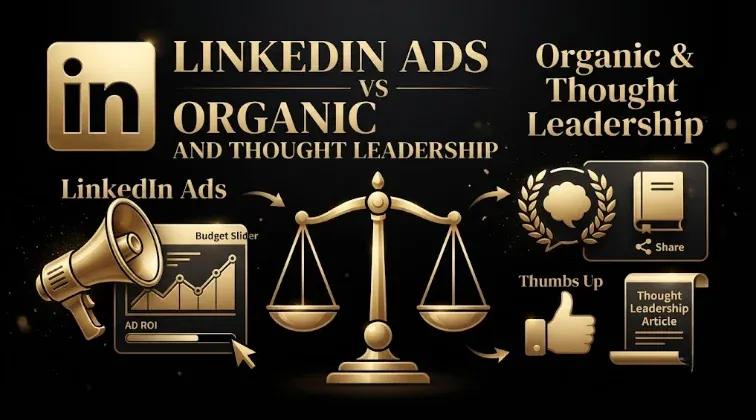
LinkedIn Ads vs Organic & Thought Leadership for B2B SaaS
The honest answer to “LinkedIn Ads or organic?” is that they solve different problems on different timelines, and the teams that win use both. Organic and thought leadership build compounding trust and category authority — but slowly, over 12–18 months, against a declining organic reach. LinkedIn Ads deliver speed, surgical targeting, and scale — but they rent attention: the moment you stop paying, the reach stops. So framing it as either/or is the mistake. The right move is to sequence and combine them — build trust and test messaging organically, scale and capture with paid, and bridge the two by promoting your best organic posts as Thought Leader Ads. This guide covers what each does well, a side-by-side comparison, when to use which, and how to combine them.
Key takeaways
- Organic/thought leadership builds compounding trust and authority over 12–18 months — durable, cheap long-term, but slow.
- LinkedIn Ads deliver speed (first leads in hours), surgical targeting, and scale — but rent attention and need budget.
- It’s not either/or — sequence them: organic to build trust and test messaging, paid to scale and capture.
- Thought Leader Ads are the bridge — boost a winning organic post from a personal profile (~$55–85 CPM, ~$150–450 per qualified lead).
- Judge both on pipeline — organic on compounding authority and inbound, paid on cost per SQL and pipeline.
What organic and thought leadership do well
Organic LinkedIn — especially thought leadership from individual people, not just a company page — builds the kind of category authority that compounds. Consistent, high-quality content over 12–18 months makes buyers associate your brand with expertise before they’re even in-market, which is enormously valuable in B2B where trust and multiple stakeholders drive decisions. It’s also a durable, owned asset: an audience you don’t pay to reach, evergreen posts that keep generating discovery, and content that pays for itself many times over. And the opportunity is real — only about 1% of LinkedIn users post weekly, yet that small group generates billions of impressions, so consistent posting stands out.
The catch is that organic is slow and increasingly hard. It can take 6–12 months of consistent posting before a steady stream of inbound appears, organic reach has been declining (even strong content reaches fewer of the right people), and you can’t control exactly who sees it. So organic is the long-term trust and authority engine — powerful and cheap over time, but not the channel for speed, precision, or a specific quarter’s pipeline.
What LinkedIn Ads do well
LinkedIn Ads are the opposite: fast, precise, and scalable. You can generate your first lead within hours of a campaign going live, target with surgical precision (company, job function, seniority, industry), scale reach with budget, and A/B test messaging at scale in a brand-safe way. That makes ads ideal for speed (testing market response, driving demos now), reaching a specific audience you couldn’t reach organically, and promoting anything time-sensitive (an event, a report, a launch).
The catch is that ads rent attention — the reach stops when the budget does — and they require sustained investment (meaningful B2B impact typically needs $3,000–$5,000+/month). B2B buyers are also ad-aware: paid content that feels like advertising (generic value props, stock imagery, aggressive CTAs) gets scrolled past or builds negative associations, so the creative has to earn attention the way organic does.
LinkedIn Ads vs organic: side by side
| Dimension | Organic / thought leadership | LinkedIn Ads |
|---|---|---|
| Speed to first result | Slow (6–12 months to steady inbound) | Fast (leads within hours) |
| Cost shape | Time and effort; no media spend | Sustained media ($3–5K+/mo; $150–450 per qualified lead) |
| Targeting | Broad, network-driven, hard to control | Surgical (role, company, seniority, industry) |
| Trust | High (a person’s insight) | Lower (ad-aware buyers discount promotion) |
| Longevity | Compounds; evergreen; owned | Rented; stops when budget stops |
| Best for | Long-term authority, compounding content | Speed, scale, time-sensitive promotion |
The pattern is clear: organic wins on trust, cost, and longevity over the long run; paid wins on speed, precision, and scale right now. Neither is strictly “better” — they’re built for different jobs, which is why the answer for most B2B SaaS companies is to run both.
When to use which
A useful filter: if the value of the content compounds over time through trust and reach, invest in organic; if it degrades quickly or depends on a specific audience seeing it at a specific time, invest in paid. Early-stage or budget-conscious companies building credibility should prioritize organic; companies with budget needing speed, scale, or time-sensitive promotion should use paid — and most established B2B SaaS companies should run both, weighted to their stage.
The hybrid play (test organically, then scale with paid)
The winning approach combines them, in sequence rather than simultaneously from a cold start. Test organically first: before spending heavily on ads, post 4–6 pieces around your key angles, engage your network, and see what actually resonates — because a strong organic presence tells you which messaging works, which makes paid campaigns dramatically more effective. Then layer paid on top to scale the winners. Concretely: test messaging organically, then scale it with paid; boost your best-performing organic posts as Thought Leader Ads; retarget the people who engage with your organic content and page; and keep a consistent organic presence so your page doesn’t look abandoned when a prospect clicks through from an ad. Organic makes paid better (sharper creative, warmer audiences), and paid makes organic reach further — run in a coordinated cadence, each amplifies the other. The one rule: don’t run both cold from scratch simultaneously; let organic inform the paid.
Thought Leader Ads: the bridge between the two
The single best mechanism for combining paid and organic is the Thought Leader Ad — paying to promote an organic post from a personal profile (a founder, an employee, even a customer) to a targeted audience. It combines the authenticity buyers trust (people trust a person’s insight over a company’s paid promotion) with the reach and precision of paid, which is why Thought Leader Ads consistently outperform standard brand-page ads — engagement rates as high as ~15%, often at a lower effective cost per click. On cost, broad B2B CPMs for these ads run roughly $55–85 in North America, with cost per qualified lead often in the $150–450 range (always confirm in Campaign Manager, since LinkedIn publishes no fixed rate). The workflow is clean: publish thought leadership organically, identify the posts that resonate, and promote those proven winners as Thought Leader Ads — the creator must approve the sponsorship. This is how you get organic’s trust and paid’s scale in one motion; just remember it still rents attention, so it complements rather than replaces the organic base.
If you’d like paid and organic built to work together for you, book a demo.
Frequently Asked Questions
Q1. Is LinkedIn Ads or organic better for B2B SaaS?
Neither outright — they solve different problems on different timelines. Organic and thought leadership build compounding trust and authority over 12–18 months (durable and cheap long-term, but slow), while LinkedIn Ads deliver speed, surgical targeting, and scale (immediate, but rented and budget-dependent). The teams that win use both: organic to build trust and test messaging, paid to scale and capture, bridged by promoting winning organic posts as Thought Leader Ads. It’s a sequence, not an either/or choice.
Q2. How do LinkedIn Ads and organic compare head to head?
Organic wins on trust (a person’s insight beats promotion), cost (time vs media spend), and longevity (compounds and is owned); paid wins on speed (leads in hours vs 6–12 months), targeting (surgical vs broad), and scale. Paid needs sustained budget ($3–5K+/month) and stops working when you stop; organic is cheap but slow to pay off. So organic is the long-term authority engine and paid is the speed-and-scale engine — different jobs, which is why most B2B SaaS companies run both.
Q3. When should you use LinkedIn organic over ads?
When you’re early-stage, budget-constrained, or focused on building long-term credibility and category authority — organic compounds over 12–18 months into a durable, owned audience you don’t pay to reach, and it’s the better home for content whose value compounds (points of view, education). The tradeoff is speed: organic can take 6–12 months to produce steady inbound, so it’s the long-term trust engine rather than the channel for a specific quarter’s pipeline.
Q4. When should you use LinkedIn Ads over organic?
When you need speed, precision, or scale — ads generate leads within hours, target specific roles and accounts you can’t reach organically, and promote time-sensitive things (events, reports, launches). They suit companies with an established budget ($3–5K+/month for meaningful impact) that need results now or want to scale a proven message. The tradeoff is that ads rent attention (reach stops when budget stops) and need genuinely good, native-feeling creative to overcome B2B ad-skepticism.
Q5. Should you combine LinkedIn Ads and organic?
Yes — but in sequence, not simultaneously from a cold start. Test your value proposition and messaging organically first (post 4–6 pieces, see what resonates), then scale the winners with paid, boost your best organic posts as Thought Leader Ads, and retarget people who engage. Organic makes paid sharper (better creative, warmer audiences) and paid extends organic’s reach. Run in a coordinated cadence so each amplifies the other, rather than running both cold at once or treating them as separate silos.
Q6. What are Thought Leader Ads and what do they cost?
Thought Leader Ads let a company pay to promote an organic post from a personal profile (a founder, employee, or customer) to a targeted audience — combining the authenticity buyers trust with paid’s reach. They outperform standard brand-page ads (engagement as high as ~15%, lower effective CPCs). Cost varies, but broad B2B CPMs run roughly $55–85 in North America with cost per qualified lead often $150–450; always confirm in Campaign Manager. The creator must approve the sponsorship for the post to run as an ad.
Q7. Does organic LinkedIn still work with declining reach?
Yes, but it’s harder and requires consistency and quality. Organic reach has been declining, so even strong content reaches fewer of the right people — but only about 1% of users post weekly, so consistent, high-quality thought leadership still stands out and compounds into authority over 12–18 months. The response isn’t to abandon organic; it’s to raise content quality and, where it matters, amplify your best organic posts with paid (Thought Leader Ads) to reach the right audience.
Q8. Which drives better pipeline, organic or paid LinkedIn?
Over the long term, organic thought leadership often drives better-quality inbound and trust-driven pipeline cheaply, because buyers who arrive through it already associate you with expertise. Paid drives faster, more controllable pipeline but at a higher cost and only while funded. The best pipeline comes from combining them: organic builds the trust and tests the message, paid scales and captures it, and Thought Leader Ads merge both. Judge organic on compounding authority and inbound, and paid on cost per SQL and pipeline.
More Featured Blogs
View All Blogs
How AI Search Is Changing B2B SaaS Buying


LinkedIn Ads vs Cold Outbound for B2B SaaS
LinkedIn Retargeting Strategy for B2B SaaS