Quick Summary
Summarize this article instantly with your preferred AI model.
How to Use LinkedIn Ads for Community-Led Growth
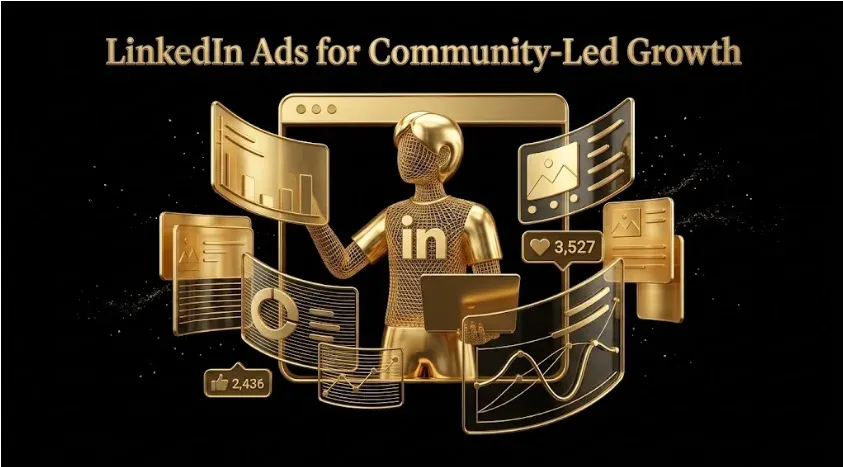
How to Use LinkedIn Ads for Community-Led Growth
In community-led growth, the engine is a community of users and advocates who help each other, spread the word, and drive adoption — so LinkedIn Ads play a supporting role, feeding and amplifying the community rather than replacing it. The mistake is treating community-led growth like a standard paid-acquisition motion, when the community itself is what drives growth and ads are there to accelerate it: bringing new people into the community, amplifying member advocacy, and reaching potential members. Ads that try to substitute for the community miss the point of the motion. This guide covers how LinkedIn Ads support community-led growth, what they do well, and what only the community can do.
Key takeaways
- In community-led growth, a community of users and advocates drives adoption — ads support it.
- Ads feed and amplify the community, they don’t replace it as the growth engine.
- Use ads to bring people into the community, amplify advocacy, and reach potential members.
- The community itself is the engine — ads accelerate and feed it rather than substituting for it.
- Measure community growth and engagement, not just leads, since the community drives the motion.
What is community-led growth?
Community-led growth is a motion where a community of users, advocates, and enthusiasts drives adoption and growth — members help each other, share their experience, advocate for the product, and bring in new people, so growth comes largely from the community’s own activity rather than from marketing alone. The community is the engine: its members’ advocacy, word of mouth, and mutual support create adoption in a way that paid acquisition on its own doesn’t.
This makes community-led growth fundamentally different from a paid-acquisition-driven motion. In a paid motion, marketing drives the growth; in a community-led motion, the community drives the growth, and marketing supports it. So the role of advertising isn’t to be the primary growth driver — it’s to feed and amplify the community that is. Understanding this distinction is essential, because it means advertising in a community-led motion should be designed to support the community, not to replace it with paid acquisition.
How do LinkedIn Ads support community-led growth?
By feeding the community with new people, amplifying its advocacy, and reaching potential members:
| Ads do | Community does |
|---|---|
| Bring new people into the community | Members help and advocate for each other |
| Amplify member content and advocacy | Word of mouth and organic spread |
| Reach potential members | Drive adoption through mutual support |
| Build awareness that feeds the community | Create the engagement that sustains growth |
The supporting role has a few forms. Ads can bring new people into the community, growing the membership that drives the motion. They can amplify community advocacy and member content, spreading the social proof and enthusiasm the community generates to a wider audience. And they can reach potential members who’d benefit from and contribute to the community. In each case, the ads are feeding and accelerating the community engine, not doing the growth work themselves — they bring fuel to the community and amplify what the community produces, while the community does the actual driving of adoption.
Why can’t ads replace the community?
Because the community’s advocacy, mutual support, and word of mouth are what drive a community-led motion, and ads can’t manufacture those. The power of community-led growth comes from real members genuinely helping each other and advocating from authentic experience — a dynamic that’s credible and self-sustaining precisely because it’s not marketing. Ads can bring people to the community and amplify what it produces, but they can’t substitute for the genuine member advocacy and mutual support that make the community valuable, because paid messaging isn’t the same as authentic peer enthusiasm. A company that tries to replace its community with paid acquisition — treating ads as the growth engine rather than a support to the community — loses what makes community-led growth work in the first place: the authentic, member-driven dynamic that paid channels can’t replicate. So ads accelerate and feed the community engine, but the engine itself is the community, and the two play different, complementary roles that shouldn’t be confused.
The community-led framework
Support community-led growth with ads deliberately:
- Recognize the community is the engine — it drives growth; ads support rather than replace it.
- Feed the community — use ads to bring new people into it, growing the membership.
- Amplify advocacy — spread member content and social proof the community generates to a wider audience.
- Reach potential members — people who’d benefit from and contribute to the community.
- Measure community outcomes — community growth and engagement, not just leads.
How do you measure community-led growth?
On community growth and engagement, alongside the downstream adoption the community drives, rather than just leads — because the community is the engine, so its health is what predicts growth. The relevant measures include whether the community is growing (new members joining), whether it’s engaged and active (members participating, helping, advocating), and whether that community activity is driving adoption and business outcomes. Ads’ contribution is measured partly by how well they feed and amplify the community — whether they bring in members and spread advocacy — rather than only by direct leads, since in a community-led motion the leads and adoption flow substantially from the community rather than directly from the ads. Judging community-supporting advertising purely on direct lead generation would misread its role, which is to strengthen the community engine, not to generate leads directly. This connects to the broader principle that advertising should be measured on the outcome it’s meant to drive: for community-supporting ads, that outcome is a healthy, growing community that drives adoption, so the measurement centers on community health and the adoption it produces. Understanding that the community is the growth engine, and that ads support it, is what makes both the strategy and its measurement coherent, rather than treating a community-led motion as if it were a standard paid-acquisition one where ads and leads are the whole story.
Frequently Asked Questions
Q1. How do you use LinkedIn Ads for community-led growth?
Use ads to support the community that drives growth — bringing new people into the community, amplifying member advocacy and content, and reaching potential members — rather than treating ads as the growth engine. In community-led growth, the community drives adoption and ads feed and accelerate it, so design advertising to strengthen the community, not to replace it with paid acquisition.
Q2. What is community-led growth?
Community-led growth is a motion where a community of users, advocates, and enthusiasts drives adoption — members help each other, share experience, advocate, and bring in new people, so growth comes largely from the community’s own activity. The community is the engine, its advocacy and word of mouth creating adoption in a way paid acquisition alone doesn’t, which makes it distinct from a marketing-driven motion.
Q3. How do ads support a community-driven motion?
By feeding the community with new people, amplifying its advocacy and member content to a wider audience, and reaching potential members who’d benefit from and contribute to it. The ads bring fuel to the community engine and spread what it produces, while the community does the actual growth work. Ads accelerate and feed the community rather than driving growth themselves.
Q4. Can ads replace a community in community-led growth?
No — the community’s authentic advocacy, mutual support, and word of mouth drive the motion, and ads can’t manufacture those. The power comes from real members genuinely helping each other from authentic experience, which paid messaging can’t replicate. A company that tries to replace its community with paid acquisition loses what makes community-led growth work: the authentic, member-driven dynamic.
Q5. Why is community more powerful than ads for some products?
Because authentic member advocacy and mutual support are credible and self-sustaining in a way marketing isn’t — real users helping each other and advocating from genuine experience creates trust and adoption that paid messaging can’t match. For products where community thrives, this member-driven dynamic drives growth more powerfully and durably than ads alone, with ads best used to feed and amplify it rather than substitute for it.
Q6. How do you grow a community with LinkedIn Ads?
Use ads to reach and bring in new members — people who’d benefit from and contribute to the community — growing the membership that drives the motion. Ads can also amplify the community’s advocacy and content to a wider audience, attracting more people to join. The goal is feeding the community with new members, so it has the participants whose activity drives growth.
Q7. How do you measure community-led growth?
On community growth and engagement — new members joining, members participating and advocating — alongside the adoption the community drives, rather than just direct leads. Ads’ contribution is measured by how well they feed and amplify the community, since in a community-led motion leads and adoption flow substantially from the community. Judging community-supporting ads purely on direct leads misreads their role.
Q8. Is community-led growth different from product-led growth?
Related but distinct. Product-led growth drives adoption through the product itself — users try it and adopt through low-friction usage. Community-led growth drives adoption through a community of users and advocates helping each other and spreading the word. Both can involve ads in a supporting role, but the engine differs: the product in one, the community in the other, each with ads accelerating rather than replacing it.
More Featured Blogs
View All Blogs
The 95/5 Rule for LinkedIn Ads


LinkedIn Thought Leader Ads for B2B SaaS
LinkedIn Ads for ABM: The B2B SaaS Playbook