Quick Summary
Summarize this article instantly with your preferred AI model.
LinkedIn Ads for Channel Partner Recruitment: The B2B Playbook
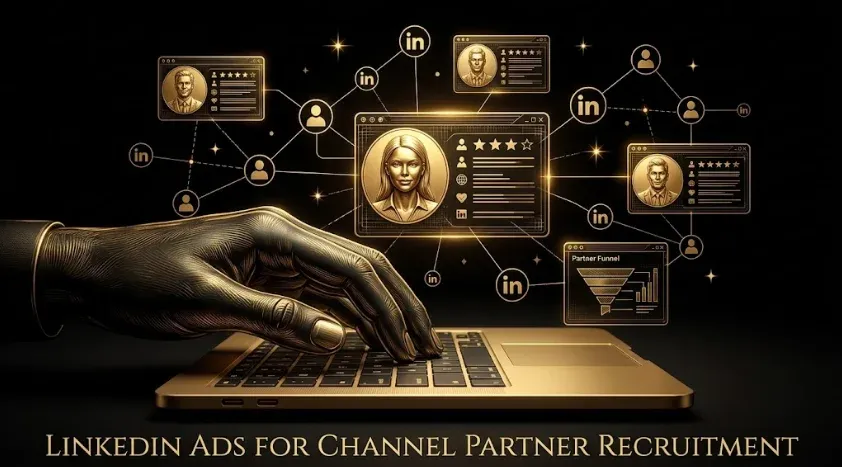
LinkedIn Ads for Channel Partner Recruitment: The B2B Playbook
LinkedIn Ads are an efficient way to recruit channel partners, resellers, and referral partners, because you can target the exact roles that run partner-eligible businesses — founders and managing partners at agencies, consultancies, and resellers — instead of your end buyers. The motion is different from lead gen: you are selling a business opportunity (margin, recurring commission, co-selling, and leads) to a company that will resell you, so the offer, funnel, and metrics all change. This playbook covers partner-role targeting, a three-stage recruitment funnel, how to frame the offer, and how to measure partner-sourced pipeline rather than cost per lead.
Key takeaways
- Target partner-type roles (Founder, Managing Partner, Head of Partnerships) at agencies and resellers — not your end-customer ICP.
- The offer is a business opportunity — margin, recurring commission, co-sell support, or qualified leads — not a product demo.
- Run a three-stage funnel: awareness, application, activation, with retargeting between stages.
- Measure cost per qualified application and partner-sourced pipeline, not cost per lead.
- Document Ads (a partner-program one-pager) and Single Image ads carry the awareness stage well.
Why partner recruitment needs its own campaign type
Most LinkedIn Ads guides mention partner recruitment only in passing, if at all — it usually shows up as a single sub-section inside a broad “everything about LinkedIn Ads” guide. That leaves partner marketing and paid social sitting in separate silos, and it means teams recruiting partners often copy their lead-gen setup and wonder why it underperforms.
Partner recruitment is a distinct motion. Your audience is not a buyer of your product; it is a business that could resell or refer your product. That changes everything downstream: the person you target, the offer you make, the funnel they move through, and the metric that tells you it worked. Treating it as its own campaign type — with its own targeting, creative, and measurement — is what makes it efficient.
Who should you target to recruit channel partners?
Target the roles that decide whether a business takes on a new partnership. At agencies, consultancies, managed service providers, resellers, and value-added resellers, that is usually the founder, managing partner, head of partnerships, or business-development lead. Build the audience from those job titles and functions, layered with company size and the industries that produce good partners for you (for example marketing services, IT services, or systems integration), and set seniority to reach decision-makers rather than delivery staff.
Then apply exclusions that matter for this specific motion: exclude your existing partners so you are not paying to re-recruit them, and exclude your end customers so the opportunity message does not confuse your buyer audience.
The 3-stage partner recruitment funnel
- Awareness — Introduce the opportunity to partner-type roles with Single Image ads and a Document Ad that carries your partner-program one-pager. Lead with the economics of partnering, not with your product.
- Application — Retarget everyone who engaged with the awareness stage using Message or Conversation Ads, or a Lead Gen Form, driving them to apply to the partner program.
- Activation — Retarget applicants who are in review with proof, FAQs, and onboarding prompts to convert an application into an active, onboarded partner.
Move people between stages with retargeting rather than showing everyone the same ad, so the message escalates as interest grows.
What offer recruits partners?
Lead with the business opportunity, stated specifically. Partners are choosing whether to invest their team’s time in your product, so the offer that matters is economics and support: a clear recurring commission percentage or margin, co-selling and lead-sharing support, deal registration, and enablement that helps them sell. Specific beats vague every time — “earn recurring commission and get co-sell support” outperforms “become a partner.” The product itself is secondary in this motion; the reason to partner is the money and the support.
Awareness versus application: targeting and format by stage
| Stage | Objective | Format | Audience | Offer | Primary KPI |
|---|---|---|---|---|---|
| Awareness | Reach partner-type roles | Single Image + Document Ad | Partner roles by firmographic | ”Earn recurring commission” | Cost per application |
| Application | Convert engagers | Message / Conversation / Lead form | Ad engagers + site visitors | ”Apply to the partner program” | Application rate |
| Activation | Onboard applicants | Single Image / Message | Applicants in review | Proof, FAQ, onboarding help | Activation rate |
How do you measure partner recruitment campaigns?
Measure the funnel on qualified applications and downstream partner value, not cost per lead. The core metrics are cost per qualified application, the rate at which applications become approved and onboarded partners, and — the number that actually matters to the business — partner-sourced pipeline and revenue, along with the share of total bookings that comes through the channel. A cheap application that never becomes an active, producing partner is not a win, so weight your optimization toward applications that convert into onboarded partners and eventual channel revenue.
Frequently Asked Questions
Q1. Can you use LinkedIn Ads to recruit channel partners?
Yes, and LinkedIn is well suited to it because you can target the exact roles that run partner-eligible businesses — founders, managing partners, and heads of partnerships at agencies and resellers. You recruit them with an opportunity-led offer and a dedicated funnel, rather than reusing your product lead-gen setup.
Q2. Who should I target to recruit resellers on LinkedIn?
Target decision-makers at businesses that could resell or refer you: founders, managing partners, heads of partnerships, and business-development leads at agencies, consultancies, MSPs, and resellers. Layer relevant industries and company size, set seniority to reach decision-makers, and exclude your existing partners and end customers.
Q3. How is partner recruitment different from lead generation on LinkedIn?
The audience is a business that could resell you, not a buyer of your product, so the offer, funnel, and metric all change. You sell a business opportunity — margin, commission, and support — through an awareness-to-application funnel, and you measure cost per qualified application and partner-sourced pipeline rather than cost per lead.
Q4. What offer works best for recruiting partners?
Lead with specific economics and support: a clear recurring commission or margin, co-selling and lead sharing, deal registration, and enablement. Partners are deciding whether to invest their team’s time, so concrete terms like “earn recurring commission and get co-sell support” outperform a generic “become a partner” message.
Q5. Which LinkedIn ad formats work for partner recruitment?
Single Image ads and a Document Ad carrying your partner-program one-pager work well for the awareness stage, because they can explain the opportunity clearly. Message or Conversation Ads and Lead Gen Forms then work for the application stage, where you retarget engaged prospects and drive them to apply to the program.
Q6. How do you structure a partner recruitment funnel?
Use three stages. Awareness introduces the opportunity to partner-type roles with Single Image and Document Ads. Application retargets engagers with Message, Conversation, or Lead Gen Form ads to drive applications. Activation retargets applicants in review with proof and onboarding prompts to turn applications into active partners.
Q7. How do you measure partner recruitment campaigns?
Track cost per qualified application, the rate at which applications become approved and onboarded partners, and partner-sourced pipeline and revenue. Also watch the share of total bookings that comes through the channel. Optimize toward applications that convert into active, producing partners rather than cheap applications that never onboard.
Q8. Should I exclude existing partners and customers from these campaigns?
Yes. Exclude current partners so you are not paying to re-recruit businesses that already work with you, and exclude your end customers so the partner-opportunity message does not confuse your buyer audience. Clean exclusions keep spend focused on genuinely new partner prospects and keep your funnels distinct.
More Featured Blogs
View All Blogs
LinkedIn Ads vs Google Ads for B2B: Which Should You Use?


LinkedIn Ads Mistakes: The 8 That Waste the Most Budget
LinkedIn Ads vs Facebook Ads for B2B: Which Should You Use?