Quick Summary
Summarize this article instantly with your preferred AI model.
LinkedIn Ads Bidding Strategies: Maximum Delivery vs Cost Cap vs Manual
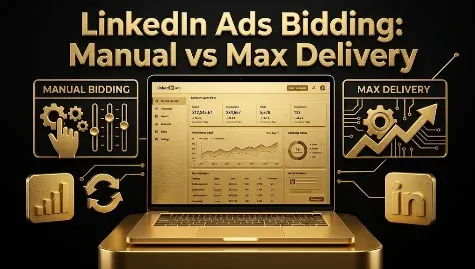
LinkedIn Ads Bidding Strategies: Maximum Delivery vs Cost Cap vs Manual
LinkedIn gives you three main bidding strategies, maximum delivery, cost cap, and manual CPC, plus CPM bidding as an advanced option. Maximum delivery is the default and the one most B2B experts avoid, because it spends your full budget aggressively with no cost control and usually a higher CPM. Manual CPC is the workhorse for most B2B and ABM campaigns, because LinkedIn’s second-price auction means you often pay below your maximum bid while keeping costs in check. Cost cap sits in the middle and is worth testing once you have a conversion baseline. This guide explains each strategy, what you are billed on, which to use by campaign type, and how to set a manual bid.
Key takeaways
- LinkedIn has three main bidding strategies: maximum delivery (automated), cost cap (also called target cost), and manual CPC (you set the maximum bid), plus CPM bidding for proven high-CTR ads.
- Maximum delivery is the default and spends your full budget aggressively, usually at a 20% to 40% higher CPM, with no cost control.
- Manual CPC is the B2B default most experts use, because the second-price auction means you often pay below your maximum bid.
- The auction ranks ads on bid multiplied by relevance, so a stronger relevance score lets a lower bid win.
- Start a manual bid about 30% below LinkedIn’s suggested range, then raise it 10% to 15% every few days until it spends, and bid for cost per qualified lead, not for spending the budget.
What are the LinkedIn bidding strategies?
LinkedIn decides which ad wins each auction on ad rank, which is your bid multiplied by your relevance score, and it bills on a second-price basis, so the winner pays just above the next bid. Because relevance is a multiplier, a strong ad can beat a higher bid: a relevance score of 8 at a 6.50 dollar bid (52) outranks a score of 4 at a 12 dollar bid (48). Your bidding strategy is how you tell LinkedIn to set that bid.
| Strategy | How it works | Cost control | Best for | Typical CPM |
|---|---|---|---|---|
| Maximum delivery | LinkedIn auto-bids to spend the full budget | None | Short, time-sensitive pushes and awareness | $90 to $120+ |
| Cost cap (target cost) | You set a target average cost; LinkedIn bids around it | Moderate (clicks can hit 2 to 3x the target) | Warm retargeting once you have a conversion baseline | $75 to $95 |
| Manual CPC | You set a maximum bid; second-price means you often pay less | High | Most B2B, ABM, and ongoing lead gen | $65 to $85 |
| CPM (manual) | You pay per 1,000 impressions instead of per click | High, once CTR is strong | Proven ads with a 1%-plus CTR | Varies with CTR |
What are you billed on?
Your objective and optimization goal decide the billing unit, which your bidding strategy then sets a price for. Most B2B campaigns bill on cost per click (CPC) for traffic and lead-gen goals or cost per 1,000 impressions (CPM) for awareness, with cost per view (CPV) for video and cost per send for message ads. The point to hold onto is that maximum delivery bills on impressions, so you pay for reach whether or not it clicks, while manual CPC ties your spend to the click you actually want.
Why do experts prefer manual CPC?
Manual CPC wins for most B2B because it gives you cost control that maximum delivery does not. LinkedIn defaults you to maximum delivery, which spends your entire budget to maximize results as LinkedIn defines them, and that convenience commonly carries a CPM 20% to 40% higher than a well-run manual campaign. Because LinkedIn uses a second-price auction, a manual bid rarely costs you the full amount, so you keep delivery to the most engaged slice of your audience at a lower cost per click. The trade-off is reach: a manual bid narrows delivery, so very small audiences can see frequency climb. For the tight, expensive B2B audiences most advertisers run, that trade is worth it.
Which bidding strategy should you use by campaign type?
Match the strategy to the campaign rather than picking one for everything.
| Campaign type | Recommended bid strategy |
|---|---|
| Cold ABM or prospecting (website visits) | Manual CPC |
| Warm retargeting (lead generation) | Cost cap or manual CPC |
| Thought leader or awareness | Maximum delivery (watch CPM daily) |
| Audiences under 50,000 members | Maximum delivery (short term) |
| Proven ads with 1%-plus CTR | CPM |
Cost cap is worth a test only once a campaign has a real conversion baseline, ideally close to 100 conversions in the last 30 days, and the move is to run manual CPC for two to four weeks first, then set the cap about 10% to 15% above your historical average cost. Remember the cap is an average, not a ceiling, so individual results can still come in above it.
How do you set and manage a manual bid?
Setting a manual bid is about five minutes of work and a simple routine after that. Start your bid around 30% below LinkedIn’s suggested range, then wait two to three days before judging, because delivery needs time to settle. If the campaign is spending less than about 90% of its daily budget, raise the bid 10% to 15% and wait another two to three days, repeating until it delivers. If it is already hitting its budget, hold the bid and put your energy into creative instead. Leave the “bid adjustments for high-value clicks” setting unchecked, because it can override your ceiling by up to 45%. One contrarian note: some teams deliberately bid above the suggestion on a brand-new campaign to gather data faster, then pull the bid down once it has learned, which is a reasonable way to speed up the first week if you can watch the spend.
Common bidding mistakes
The biggest mistake is simply leaving maximum delivery on as the default, which hands LinkedIn full control of your costs. Close behind is raising the budget on a maximum delivery campaign that is underperforming, which usually lifts the CPM rather than the reach. Setting a cost cap too low backfires too, because delivery can stop entirely rather than just slow down. Starting your bid at the top of the suggested range overpays from day one. And leaving the high-value-click adjustment enabled quietly overrides the bid you set.
Bid for pipeline, not for spend
Here is the thread that ties it together. Maximum delivery is the default because it spends your whole budget, which serves LinkedIn’s revenue more reliably than it serves your cost per qualified lead. Manual CPC flips that: you decide what a click is worth, keep the CPC and CPM in check, and spend only where it pays. So bid to control cost, judge each strategy on the cost per qualified lead and pipeline it produces rather than on how fast it spends, and treat a fully spent budget as a question, not a win. If you want your LinkedIn bidding set up to control cost against pipeline, you can book a demo.
Frequently Asked Questions
Q1. What are the LinkedIn ad bidding strategies?
LinkedIn offers maximum delivery, where LinkedIn auto-bids to spend your full budget; cost cap (also called target cost), where you set a target average cost; and manual CPC, where you set the maximum you will pay per click. CPM bidding, paying per 1,000 impressions, is an advanced option for proven high-CTR ads. Maximum delivery is the default, but manual CPC gives most B2B campaigns the cost control they need.
Q2. What is the difference between maximum delivery and manual bidding?
Maximum delivery prioritizes spending your whole budget and lets LinkedIn set the bids on an impression basis, so costs are unpredictable and CPMs run higher. Manual bidding prioritizes cost control: you cap the bid per click, and the second-price auction means you often pay less. Maximum delivery suits short pushes; manual CPC suits ongoing B2B and ABM where efficiency matters.
Q3. Which LinkedIn bidding strategy is best?
For most B2B and ABM, manual CPC is best, because it controls cost and typically delivers a 20% to 40% lower CPM than maximum delivery. Maximum delivery suits short awareness pushes and thought leader ads. Cost cap suits warm retargeting once you have a conversion baseline, and CPM suits ads that already run above a 1% click-through rate.
Q4. How do you set a manual bid on LinkedIn?
Start about 30% below LinkedIn’s suggested range, wait two to three days, then if the campaign is spending under about 90% of its daily budget, raise the bid 10% to 15% and wait again. If it is hitting budget, hold the bid and improve creative. Turn off “bid adjustments for high-value clicks,” which can override your ceiling by up to 45%.
Q5. What is cost cap bidding on LinkedIn and when should you use it?
Cost cap lets you set a target average cost per result, and LinkedIn bids to keep the average near it, though individual results can exceed it. Use it for warm retargeting once a campaign has a solid conversion baseline, ideally near 100 conversions in 30 days. Run manual CPC first for two to four weeks, then set the cap about 10% to 15% above your average.
Q6. What is CPM bidding on LinkedIn?
CPM bidding charges per 1,000 impressions rather than per click. It only makes sense once an ad consistently earns a high click-through rate (around 1% or more), because at that point paying for impressions can work out cheaper per click than bidding on clicks directly. Do not start a new campaign on CPM; earn the CTR first, then test it.
Q7. Why does LinkedIn default to maximum delivery?
Because maximum delivery reliably spends your full budget, which maximizes LinkedIn’s revenue, not necessarily your efficiency. It is convenient and fine for short pushes or awareness, but it gives you no cost control and usually a higher CPM. For ongoing B2B campaigns, switching to manual CPC almost always lowers your costs.
Q8. Does relevance score affect how much you pay when bidding?
Yes. The auction ranks ads on bid multiplied by relevance, so a higher relevance score lets a lower bid win and lowers your effective cost. A weak relevance score can roughly double your effective CPC, while a strong one earns cheaper delivery. Improving the ad is often a better cost lever than raising the bid.
More Featured Blogs
View All Blogs
LinkedIn Ads Campaign Structure: How to Organize for Scale


LinkedIn Ads: Daily vs Lifetime Budget, and When to Use Each
LinkedIn Ads Targeting: Job Function vs Job Title vs Seniority