Quick Summary
Summarize this article instantly with your preferred AI model.
How to Write LinkedIn Ad Copy for Cold vs Warm Audiences
How to Write LinkedIn Ad Copy for Cold vs Warm Audiences
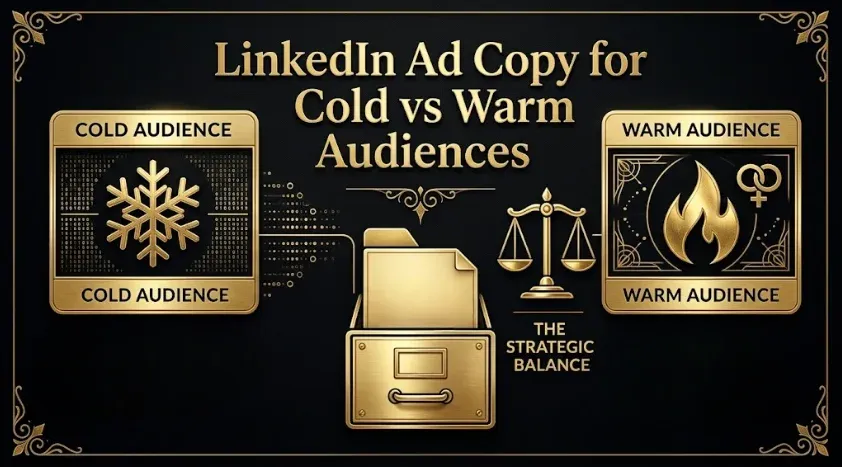
The same product needs different copy depending on whether the audience has never heard of you or already knows you — and using one message for both is why campaigns underperform. Cold audiences need a hook, a reason to care, and qualification; they’re not ready for a demo pitch. Warm audiences, who’ve engaged before, need proof and objection-handling to move toward a decision. Hot audiences, showing real intent, need a clear offer and a strong reason to act now. Matching your message to audience temperature is one of the highest-leverage things you can do in LinkedIn copy, because a message that’s right for one stage actively fails at another. This guide covers how to write for each.
Key takeaways
- The same product needs different copy by audience temperature — cold, warm, and hot are different conversations.
- Cold audiences need a hook, relevance, and qualification — not a demo pitch they’re not ready for.
- Warm audiences need proof and objection-handling to move from interest toward a decision.
- Hot audiences need a clear offer and a reason to act now — don’t re-introduce the basics.
- A message that’s right for one temperature actively fails at another.
Why does audience temperature change your copy?
Because a cold prospect and a warm one are in completely different states of mind. A cold audience doesn’t know you exist, so your copy has to earn attention and establish relevance before it can ask for anything. A warm audience already knows you — they’ve seen your ads or engaged with your content — so copy that re-introduces the basics wastes their time and your budget, while copy that provides proof moves them forward. A hot audience is close to deciding, so copy that hooks and educates instead of making a clear offer squanders the moment.
Sending the same message to all three means it’s wrong for at least two of them. The cold audience gets a pitch they’re not ready for; the hot audience gets an introduction they don’t need. Temperature-matched copy speaks to where the person actually is.
How do you write for cold audiences?
Earn attention and qualify. A cold audience needs a hook that stops the scroll, a clear signal of who this is for, and a specific pain they recognize — all before any ask. The job of cold copy is to make the right person think “this is about my problem,” not to close a sale. So lead with the pain or a sharp question, establish relevance to their role, and offer a low-commitment next step (a piece of content, an insight) rather than a demo. Cold copy that opens with “book a demo” fails because it asks for commitment from someone who doesn’t yet know why they’d want to.
How do you write for warm audiences?
Provide proof and handle objections. A warm audience has already registered who you are, so the job now is to build trust and move them toward considering you seriously. This is where proof belongs: a customer outcome, a relevant case, a concrete result that substantiates the claim your cold ad made. It’s also where you address the objections that stall consideration — the missing-feature worry, the “is this really better” question, the risk concern. Warm copy assumes familiarity and builds on it, rather than starting over.
How do you write for hot audiences?
Make the offer and give a reason to act. A hot audience — people who’ve hit your pricing page, requested information, or engaged repeatedly — is close to a decision, so copy should be direct: a clear offer, a strong single call to action, and a reason to act now rather than later. This is the one stage where urgency and a direct ask are appropriate, because the person is ready for them. Hot copy that hedges, educates, or re-introduces your product wastes a moment of high intent that’s expensive to create.
| Audience | State of mind | Message | CTA |
|---|---|---|---|
| Cold | Doesn’t know you | Hook, relevance, specific pain | Low-commitment (content, insight) |
| Warm | Knows you, considering | Proof, objection-handling | Consideration step (case study, demo) |
| Hot | Ready to decide | Clear offer, reason to act | Direct action (demo, buy, contact) |
The temperature-matching framework
Structure copy to the stage:
- Identify the audience temperature — cold prospecting, warm retargeting, or hot high-intent — before writing.
- Match the goal. Cold earns attention and qualifies; warm builds trust and consideration; hot converts.
- Match the message. Hook and pain for cold; proof and objections for warm; offer and urgency for hot.
- Match the ask. Escalate the CTA with temperature — low-commitment for cold, direct for hot.
- Don’t reuse across stages. Write distinct copy per temperature rather than one message stretched across all.
What happens if you mismatch copy to temperature?
You lose people at both ends. Pitch a cold audience like they’re hot — lead with a demo request to strangers — and you get low response, because you asked for commitment before earning it. Treat a hot audience like they’re cold — re-introduce your product to someone ready to buy — and you waste a high-intent moment that cost real money to create, letting a ready buyer cool off or go to a competitor who made the offer. The most common version of this mistake is running one message to everyone, which is really a cold message shown to warm and hot audiences (wasting their readiness) or a hot message shown to cold audiences (asking too much too soon). Matching copy to temperature fixes both failures at once.
Frequently Asked Questions
Q1. How do you write LinkedIn ad copy for cold audiences?
Earn attention and qualify. A cold audience doesn’t know you, so lead with a hook and a specific pain they recognize, signal clearly who it’s for, and offer a low-commitment next step like a piece of content rather than a demo. The goal is making the right person think “this is about my problem,” not closing a sale.
Q2. How is copy for warm audiences different?
Warm audiences already know you, so copy should provide proof and handle objections to move them toward a decision, rather than re-introducing the basics. Use a customer outcome or relevant case to substantiate the claim your cold ad made, and address the concerns that stall consideration. Warm copy builds on familiarity instead of starting over.
Q3. What should hot-audience LinkedIn copy say?
Make a clear offer with a strong single call to action and a reason to act now. Hot audiences — pricing-page visitors, information-requesters, repeat engagers — are close to deciding, so this is the one stage where urgency and a direct ask are appropriate. Copy that hedges or re-introduces your product wastes a high-intent moment that was expensive to create.
Q4. Why can’t you use the same copy for all audiences?
Because cold, warm, and hot audiences are in different states of mind, so one message is wrong for at least two of them. A cold audience gets a pitch they’re not ready for; a hot audience gets an introduction they don’t need. Temperature-matched copy speaks to where the person actually is in their journey.
Q5. What is audience temperature in advertising?
Audience temperature describes how familiar and ready-to-buy an audience is. Cold audiences don’t know you; warm audiences have engaged and know you; hot audiences show real buying intent. Temperature determines what your copy should do — earn attention, build trust, or convert — and matching copy to it is one of the highest-leverage things in LinkedIn advertising.
Q6. Should cold audiences see a demo CTA?
Usually not. A demo request asks for commitment from someone who doesn’t yet know why they’d want one, so cold copy leading with “book a demo” typically underperforms. Offer a low-commitment next step instead — content, an insight, a resource — and save the demo ask for warm and hot audiences who’ve already engaged and understand your value.
Q7. How do you match CTAs to audience temperature?
Escalate the ask with temperature. Cold audiences get a low-commitment CTA like reading content; warm audiences get a consideration step like a case study or demo; hot audiences get a direct action like requesting a demo, contacting sales, or buying. The CTA should match how ready the audience is to commit, not ask for more than the stage supports.
Q8. What happens if you mismatch copy to audience temperature?
You lose people at both ends. Pitching a cold audience like they’re hot gets low response because you asked for commitment too early; treating a hot audience like they’re cold wastes a high-intent moment and lets ready buyers cool off. The common version is one message for everyone, which mismatches at least two of the three temperatures.
More Featured Blogs
View All Blogs
Why LinkedIn Ads and Google Analytics Numbers Never Match



LinkedIn Business Manager: What It Is and Who Needs It
LinkedIn Ad Character Limits: The Reference for Every Format