Quick Summary
Summarize this article instantly with your preferred AI model.
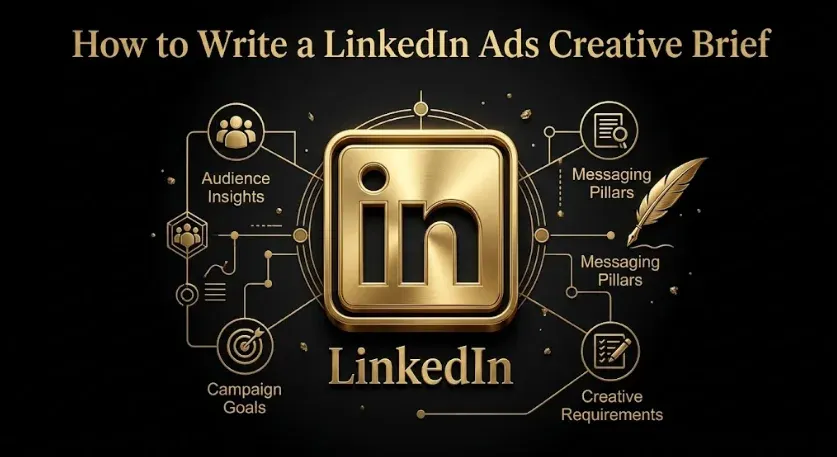
How to Write a LinkedIn Ads Creative Brief
How to Write a LinkedIn Ads Creative Brief
A creative brief gives whoever makes your ads the inputs they need to make ones that work — the audience, the offer, the core message, the proof, and the single call to action — before anyone opens a design tool. Most bad ads trace back to a bad or missing brief: unclear about who the ad is for, vague about the offer, with no proof and no single action. When the brief is fuzzy, the ad is generic, because the person making it had to guess at the fundamentals. A good brief forces clarity on those fundamentals upfront, which is where ad quality is actually decided. This guide covers what a LinkedIn Ads creative brief should contain and why each input matters.
Key takeaways
- A creative brief supplies the inputs that make good ads before production starts.
- Most bad ads trace to a bad or missing brief — unclear audience, vague offer, no proof.
- The essentials: audience, offer, core message, proof, single CTA, and context.
- A good brief forces clarity on the fundamentals, which is where ad quality is decided.
- The brief is where you prevent generic ads — not in the design, but in the thinking before it.
Why does a creative brief matter?
Because ad quality is decided in the thinking before the design, not in the design itself. A designer or copywriter can only make an ad as clear as the brief they’re given — if the brief doesn’t specify who the ad is for, what it’s offering, and why anyone should care, the resulting ad will be vague on exactly those points. Most weak ads aren’t a failure of execution; they’re a failure of the brief that preceded them, which left the fundamentals unclear.
A good brief front-loads the hard thinking: it forces you to decide the audience, offer, and message before production, so the person making the ad is executing a clear idea rather than guessing at one. This is why the brief, not the design tool, is where you prevent generic ads — clarity upstream produces clarity in the output.
What should a creative brief contain?
The inputs that determine whether the ad works. A complete LinkedIn Ads brief specifies:
| Brief element | What it answers |
|---|---|
| Objective | What this ad is meant to achieve |
| Audience / persona | Who exactly this ad is for |
| Pain / problem | The specific problem this audience feels |
| Core message | The single main point the ad makes |
| Proof | The evidence that backs the claim |
| Call to action | The one action you want |
| Context | Funnel stage and audience temperature |
| Format & brand | The format and tone/brand guidelines |
Each of these shapes the ad. Miss the audience and the ad speaks to no one; miss the proof and it’s an unsubstantiated claim; miss the single CTA and it asks for several things and gets none. The brief’s job is to settle all of these before production.
Why is the audience the most important input?
Because everything else depends on who the ad is for. The message, the pain, the proof, and the tone all change depending on the audience — an ad for a CFO is a different ad from one for an engineer, even for the same product. If the brief is vague about the audience (“B2B decision-makers”), the ad will be vague too, trying to speak to everyone and landing with no one. A precise audience in the brief — a specific role, in a specific situation, with a specific problem — is what lets every other element be specific. The single most common brief failure is an unclear audience, which cascades into a generic ad, because the person making it had no specific person to write for.
How does the brief handle offer and proof?
By making both explicit, since ads fail without them. The offer is what you’re asking the person to do or giving them — and a brief that’s vague about the offer produces an ad with a weak or unclear ask. State exactly what the offer is and why the audience would want it. The proof is the evidence that makes the claim credible — a result, a number, a customer outcome — and without it in the brief, the ad makes assertions a skeptical B2B audience won’t believe. A brief that specifies a clear offer and concrete proof gives the ad both a reason to act and a reason to trust, which are the two things a weak ad usually lacks.
The creative brief framework
Write a brief that produces good ads:
- State the objective — what the ad should achieve, so production aims at the right outcome.
- Define the audience precisely — a specific role, situation, and problem, not a vague segment.
- Name the pain and the message — the specific problem and the single main point that addresses it.
- Provide the proof — concrete evidence that backs the claim for a skeptical audience.
- Specify one CTA and the context — the single action, plus funnel stage, temperature, format, and brand.
What happens without a good brief?
You get generic ads and waste production effort. Without a clear brief, the person making the ad guesses at the audience, offer, and message — and their guesses produce something broad enough to cover the uncertainty, which is exactly what a generic ad is. Then you iterate on the output, tweaking headlines and images, trying to fix in production what was never decided in the brief — polishing an ad whose fundamentals are unclear. This is slow and rarely works, because the problem isn’t the execution; it’s the missing thinking upstream. Writing a proper brief first is faster overall and produces far better ads, because it settles the audience, offer, message, and proof once, clearly, so the ad executes a strong idea instead of hedging an unclear one. The brief is the cheapest place to get the ad right.
Frequently Asked Questions
Q1. How do you write a LinkedIn Ads creative brief?
Specify the inputs that determine whether the ad works: the objective, a precise audience, the specific pain, the core message, concrete proof, a single call to action, and the context (funnel stage, temperature, format, brand). A good brief settles these fundamentals before production, so the person making the ad executes a clear idea rather than guessing.
Q2. What should a creative brief include?
Objective, audience or persona, the specific pain the audience feels, the core message, proof that backs the claim, a single call to action, context like funnel stage and audience temperature, and format and brand guidelines. Each shapes the ad — miss the audience and it speaks to no one, miss proof and it’s an unsubstantiated claim.
Q3. Why do most bad ads come from a bad brief?
Because ad quality is decided in the thinking before the design, and a designer can only make an ad as clear as the brief allows. A vague brief — unclear audience, vague offer, no proof — produces an ad vague on exactly those points. Most weak ads are a brief failure, not an execution failure.
Q4. What is the most important part of a creative brief?
The audience, because everything else depends on who the ad is for. The message, pain, proof, and tone all change with the audience — an ad for a CFO differs from one for an engineer. A vague audience produces a vague ad that speaks to everyone and lands with no one. A precise audience lets every other element be specific.
Q5. How do you brief the offer in a creative brief?
State exactly what you’re asking the person to do or giving them, and why the audience would want it. A brief vague about the offer produces an ad with a weak or unclear ask. Being explicit about the offer — and that it’s something the specific audience genuinely values — gives the ad a clear reason to act.
Q6. Should a creative brief include proof?
Yes. Proof is the evidence that makes the claim credible to a skeptical B2B audience — a result, a number, a customer outcome. Without proof specified in the brief, the ad makes assertions buyers won’t believe. Including concrete proof gives the ad a reason to be trusted, which, alongside a clear offer, is what weak ads usually lack.
Q7. How does a brief prevent generic ads?
By forcing clarity on the fundamentals before production. When the brief precisely defines the audience, offer, message, and proof, the person making the ad executes a clear idea rather than guessing — and guessing is what produces generic ads. The brief front-loads the hard thinking, so ad quality is decided upstream where it’s cheapest to get right.
Q8. What happens if you skip the creative brief?
The person making the ad guesses at the audience, offer, and message, producing something broad enough to cover the uncertainty — a generic ad. Then you iterate in production, tweaking headlines to fix what was never decided, which is slow and rarely works. A proper brief first is faster overall and produces far better ads.
More Featured Blogs
View All Blogs
LinkedIn Ads for Founders & Early-Stage B2B SaaS


Stop Optimizing Your LinkedIn Ads for CTR
B2B SaaS LinkedIn Ad Examples That Convert (2026)