Quick Summary
Summarize this article instantly with your preferred AI model.
Full-Funnel LinkedIn Ads Explained
Full-Funnel LinkedIn Ads Explained
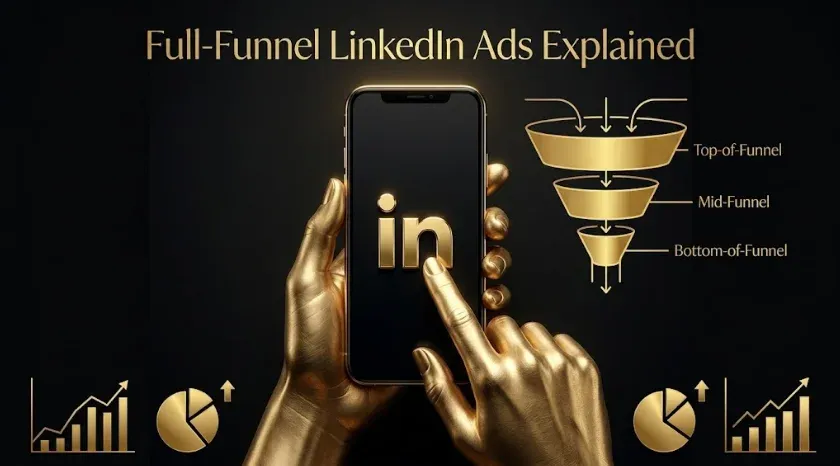
Full-funnel LinkedIn Ads means running campaigns across every stage of the buyer journey — awareness, consideration, and conversion — with creative and offers matched to each stage, rather than only running conversion asks. The reason it matters is simple: asking a cold audience to convert fails, because they don’t know you yet, so a program that only runs bottom-funnel “book a demo” ads to cold audiences wastes most of its spend. A full-funnel approach builds awareness first, nurtures consideration, and then converts warmed audiences — matching the size of the ask to where the buyer actually is. This guide covers what full-funnel means, the role of each stage, and how to match creative and offers to the funnel.
Key takeaways
- Full-funnel means running ads across awareness, consideration, and conversion stages.
- Cold audiences won’t convert — asking them to buy immediately wastes spend.
- Each stage needs creative and offers matched to it, not one conversion ask for everyone.
- Full-funnel builds awareness, nurtures consideration, then converts warmed audiences.
- It creates a pipeline of warming prospects rather than a single pass-or-fail conversion attempt.
What does full-funnel mean?
Running ads across the whole buyer journey, with each stage doing its own job. The buyer journey has stages — from not knowing you exist (awareness), to evaluating whether you’re right (consideration), to being ready to act (conversion) — and full-funnel means running campaigns for each, rather than only the final conversion stage. At the top, you build awareness among people who don’t know you; in the middle, you nurture consideration among those who do; at the bottom, you convert those who are ready.
The alternative — running only bottom-funnel conversion campaigns — assumes everyone is ready to convert, which most of your audience isn’t. A full-funnel approach recognizes that buyers are at different stages and meets each where they are: building awareness with cold audiences rather than asking them to buy, nurturing warming audiences toward readiness, and converting warm audiences who are ready. Full-funnel is about covering the whole journey, so you’re not just harvesting the small fraction of ready buyers but also building and warming the much larger group who aren’t ready yet.
Why do cold audiences need the top of the funnel?
Because asking someone who’s never heard of you to convert fails, so cold audiences need awareness before any conversion ask. A cold audience doesn’t know you, doesn’t trust you, and has no reason to act on a demo or purchase request — so a bottom-funnel ask lands on people who aren’t ready, and most ignore it. Running only conversion campaigns to cold audiences is asking for a commitment before you’ve earned it, which wastes spend on people who need earlier-stage engagement first.
The top of the funnel solves this by building the awareness and familiarity that make later conversion possible. When you first build awareness with a cold audience — introducing yourself, providing value, becoming familiar — you create the conditions for them to convert later, once they know and trust you. Skipping this and going straight to conversion asks means either wasting spend on unready cold audiences or being limited to the small pool already warm. Full-funnel’s top stage is what feeds the rest of the funnel, turning cold audiences into ones that can eventually convert.
How do you match creative and offers to each stage?
By giving each stage the creative and offer suited to where the buyer is:
| Stage | Buyer state | Creative & offer |
|---|---|---|
| Awareness (top) | Doesn’t know you | Broad, educational, valuable — no hard ask |
| Consideration (middle) | Knows you, evaluating | Engaging content that builds trust and interest |
| Conversion (bottom) | Ready to act | Direct ask — demo, trial, purchase |
At the awareness stage, the creative is broad and educational, providing value and building familiarity without a hard conversion ask, because the audience isn’t ready for one. At the consideration stage, the content engages and builds trust — deeper value, proof, and reasons to consider you — moving the audience toward readiness. At the conversion stage, the offer is the direct ask — a demo, trial, or purchase — because the audience is now warm and ready. Matching creative and offer to stage means each ad asks for something appropriate to where the buyer is, rather than asking cold audiences to convert or boring warm audiences with introductory content.
The full-funnel framework
Run a full-funnel program deliberately:
- Cover all stages — awareness, consideration, and conversion, not just conversion.
- Build awareness with cold audiences — introduce yourself and provide value, no hard ask.
- Nurture consideration — engaging content that builds trust and moves warming audiences toward readiness.
- Convert warm audiences — direct asks for the audiences who are now ready.
- Match creative and offer to stage — each ask appropriate to where the buyer is.
How does full-funnel create a pipeline of warming prospects?
By moving people through the stages, so the top continuously feeds the bottom. In a full-funnel program, awareness campaigns bring cold audiences in and build familiarity, consideration campaigns warm those audiences toward readiness, and conversion campaigns convert the ones who arrive ready — so the funnel is a system where each stage feeds the next, continuously producing warm, convertible prospects rather than relying on a fixed pool. This is fundamentally different from a conversion-only approach, which can only harvest whoever is already warm and produces nothing once that pool is exhausted. A full-funnel program keeps generating its own warm audiences by building and nurturing them, so the conversion stage always has a supply of ready prospects to convert. The awareness and consideration stages, which don’t convert directly and might look like they underperform on immediate metrics, are what make the conversion stage sustainable — they’re the top of a pipeline that feeds warmed prospects downstream. This is why judging awareness campaigns on immediate conversions misreads their role: they’re building the pipeline that the conversion stage draws on, and a program that cuts them to focus only on conversion eventually starves the conversion stage of the warm audiences it needs. Full-funnel is ultimately about building a self-sustaining pipeline where you create demand, warm it, and convert it, rather than competing for the limited pool of buyers who happen to already be ready.
Frequently Asked Questions
Q1. What are full-funnel LinkedIn Ads?
Full-funnel means running campaigns across every stage of the buyer journey — awareness, consideration, and conversion — with creative and offers matched to each stage, rather than only running conversion asks. It builds awareness with cold audiences, nurtures consideration among warming ones, and converts warm audiences who are ready, meeting buyers where they are rather than asking everyone to convert immediately.
Q2. Why can’t you just run conversion ads?
Because most of your audience isn’t ready to convert, so conversion-only campaigns either waste spend on unready cold audiences or are limited to the small pool already warm. Asking a cold audience to book a demo fails, since they don’t know or trust you. Conversion-only misses the much larger group who need earlier-stage engagement before they can convert.
Q3. Why do cold audiences need awareness first?
Because asking someone who’s never heard of you to convert fails — a cold audience has no reason to act on a demo or purchase request. Building awareness first introduces you, provides value, and creates the familiarity and trust that make later conversion possible. The top of the funnel turns cold audiences into ones that can eventually convert, feeding the rest of the funnel.
Q4. How do you match creative to funnel stages?
Give each stage suitable creative: broad, educational, value-first content with no hard ask at awareness; engaging, trust-building content at consideration; and direct asks like a demo or trial at conversion. Each ad asks for something appropriate to where the buyer is, rather than asking cold audiences to convert or showing warm audiences introductory content they’re past.
Q5. What offer works at each stage of the funnel?
At awareness, no hard offer — just value and familiarity, since the audience isn’t ready. At consideration, content that engages and builds trust, moving them toward readiness. At conversion, the direct offer — demo, trial, or purchase — because the audience is now warm and ready. The offer’s size matches the buyer’s readiness, escalating as they move down the funnel.
Q6. How does full-funnel create a pipeline?
By moving people through the stages so the top continuously feeds the bottom — awareness brings cold audiences in, consideration warms them, and conversion converts the ready ones. The funnel becomes a system where each stage feeds the next, continuously producing warm prospects rather than relying on a fixed pool. It generates its own warm audiences instead of only harvesting existing ones.
Q7. Should you measure awareness campaigns on conversions?
No — awareness campaigns build the pipeline the conversion stage draws on, so judging them on immediate conversions misreads their role. They don’t convert directly; they create and warm the audiences that convert later. Measure them on their job — building awareness and feeding the funnel — while measuring conversion campaigns on conversions. Cutting awareness to focus only on conversion eventually starves the funnel.
Q8. Is full-funnel better than conversion-only advertising?
For sustainable growth, generally yes. Conversion-only can only harvest whoever is already warm and produces nothing once that pool is exhausted. Full-funnel keeps generating its own warm audiences by building and nurturing them, so the conversion stage always has ready prospects. It’s the difference between competing for a limited pool of ready buyers and building a self-sustaining pipeline of demand.
More Featured Blogs
View All Blogs
How to Use the LinkedIn Ad Library for Competitor Research


LinkedIn Carousel Ads: What the Specs and Data Say
The 95/5 Rule for LinkedIn Ads