Quick Summary
Summarize this article instantly with your preferred AI model.
B2B SaaS Pipeline Stages Defined: Lead, MQL, SQL, Opportunity, Closed-Won (2026 Benchmarks)
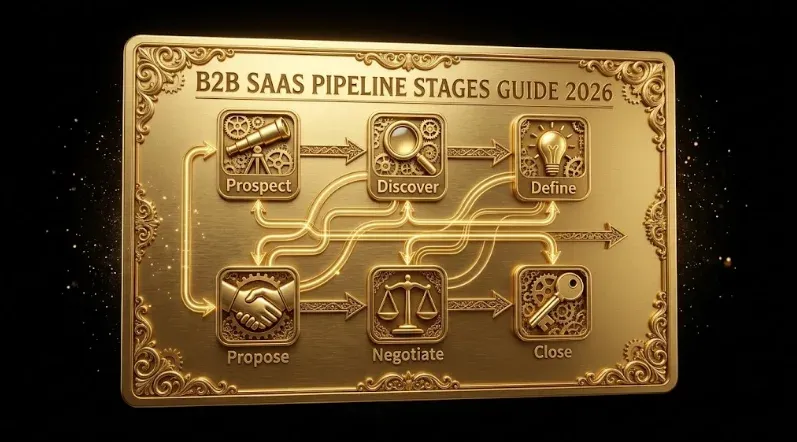
B2B SaaS pipeline progresses through 5 stages: Lead → MQL (Marketing Qualified Lead) → SQL (Sales Qualified Lead) → Opportunity → Closed-Won. Conversion benchmarks for 2026: Lead→MQL converts at 31-41%, MQL→SQL at 13% cross-industry average / 18-22% B2B SaaS average / 25-35% top performers, SQL→Opportunity at 30-59%, Opportunity→Closed-Won at 22-30%. Time-to-convert: visitor→lead in 1-3 days, MQL→SQL in 8-15 days, Opportunity→close in 30-45 days for SMB / 120+ days for enterprise. The MQL→SQL stage is consistently where the largest pipeline volume is lost — making it the highest-ROI stage to optimize.
Key Takeaways
- B2B SaaS pipeline has 5 standard stages: Lead → MQL → SQL → Opportunity → Closed-Won.
- MQL→SQL conversion is the biggest bottleneck: 13% cross-industry average, 18-22% B2B SaaS average, 25-35% top performers, 39-40% with behavioral ICP scoring.
- Opportunity→Closed-Won averages 22-30% for B2B SaaS, with top quartile exceeding 30%.
- Time-to-convert varies by ACV: SMB 30-45 day Opp→Close cycles, Enterprise 120+ day cycles.
- Lead-to-customer overall conversion averages 1-5%; above 5% is considered strong.
- Marketing-sourced pipeline contribution should be 30-50% of total pipeline for balanced motions.
The 5 Standard Pipeline Stages
Every B2B SaaS pipeline tracks contact progression through 5 qualification thresholds. Each stage represents an explicit increase in buying signal and sales engagement:
| Stage | Definition | Owner | Conversion to Next |
|---|---|---|---|
| 1. Lead | First contact captured (form, content, list import) | Marketing | 31-41% to MQL |
| 2. MQL (Marketing Qualified Lead) | Lead matches ICP + showed sufficient engagement | Marketing | 13-35% to SQL |
| 3. SQL (Sales Qualified Lead) | Sales has accepted and qualified through conversation | Sales | 30-59% to Opportunity |
| 4. Opportunity | Real sales conversation; budget/timeline/need confirmed | Sales | 22-30% to Closed-Won |
| 5. Closed-Won | Contract signed; customer onboarded | Sales | — (end stage) |
Each stage is a filter. Buyers who don’t pass the filter exit the funnel (either churn out or get nurtured for future re-engagement). This stage-by-stage qualification is what enables accurate forecasting and revenue prediction.
Stage 1: Lead Definition and Benchmarks
Definition: A Lead is any contact who has provided their information through a form, content download, event registration, or similar capture mechanism. Not all leads are qualified — most aren’t.
Entry criteria:
- Contact information captured (name + email minimum; usually company + role)
- Some indication of interest (filled form, attended webinar, downloaded content)
- Hasn’t been disqualified by automated checks
Benchmarks for visitor-to-lead conversion:
| Vertical | Visitor → Lead Rate |
|---|---|
| HR Tech | 3-6% (high demo intent) |
| B2B SaaS (median) | 2-5% |
| Cybersecurity | 1-2% (longer evaluation cycles) |
| Enterprise Software | 1-3% |
| Average B2B | 2.3% |
Why this matters for LinkedIn Ads: LinkedIn Lead Gen Forms convert at 13% on average (much higher than landing pages at 4%), making LinkedIn an efficient first-stage capture mechanism — but most leads will still fall out before reaching SQL.
Stage 2: MQL (Marketing Qualified Lead)
Definition: An MQL is a Lead that has been qualified by marketing as worth handing to sales. Qualification combines firmographic fit (ICP match) with behavioral signal (engagement intensity).
Entry criteria:
- Firmographic fit (company size, industry, geography match ICP)
- Behavioral engagement (multiple form fills, demo-intent page visits, scoring threshold reached)
- Not on disqualification list (current customer, competitor, churned, free-tier capped)
Benchmarks: Lead → MQL conversion
| Source | Lead → MQL Rate |
|---|---|
| Website organic traffic | 31.3% |
| Referral leads | 24.7% |
| Webinar attendees | 17.8% |
| Paid LinkedIn (with ICP filtering) | 25-35% |
| Paid LinkedIn (without ICP filtering) | 15-22% |
| Cold outbound | 8-12% |
| B2B SaaS average | 31-41% |
Why teams under-perform here:
- MQL definitions are too loose (any form fill → MQL)
- Behavioral scoring not connected to ICP scoring
- No ICP fit check before MQL designation
- Marketing optimizing for MQL volume not MQL quality
The fix: require both ICP fit (firmographic) AND behavioral signal (engagement) for MQL status. Companies using behavioral + firmographic ICP scoring see Lead→MQL rates 5-10 points higher.
Stage 3: SQL (Sales Qualified Lead)
Definition: An SQL is an MQL that sales has accepted and qualified through direct conversation. Sales has confirmed the contact has budget, authority, need, and timeline (BANT) or passed a MEDDIC evaluation.
Entry criteria:
- Sales rep has had a qualifying conversation
- Budget exists or can be created
- Decision-maker or champion identified
- Need confirmed and connected to your solution
- Timeline defined (even if 6+ months for enterprise)
MQL → SQL Conversion Benchmarks:
| Source | MQL → SQL Rate |
|---|---|
| Cross-industry average | 13% |
| B2B SaaS average | 18-22% |
| B2B SaaS top quartile | 25-35% |
| Teams using ICP behavioral scoring | 39-40% |
| Healthcare / Oil & Gas | 12-13% (longer cycles) |
The MQL→SQL gap is the single biggest pipeline leakage point. A 5-point improvement in MQL→SQL rate typically lifts revenue by ~18% because every downstream stage compounds.
Why MQL→SQL is the highest-leverage optimization:
- Below the MQL stage, you’re processing high-volume / low-conversion traffic
- Above the SQL stage, sales conversion mechanics dominate (less room for marketing improvement)
- MQL→SQL is where marketing-quality directly translates to sales acceptance
This is also why LinkedIn Value-Based Bidding (which optimizes for SQL events, not form fills) drives such large performance improvements — it directly addresses the MQL→SQL conversion gap. See LinkedIn Value-Based Bidding for implementation.
Stage 4: Opportunity
Definition: An Opportunity is an SQL that has progressed into active evaluation — the buyer is comparing solutions, may have demoed, and is moving toward a buying decision. The opportunity has a forecasted close date and deal value.
Entry criteria:
- SQL has progressed past initial conversation
- Buyer is actively evaluating your solution
- Specific use case or pain point documented
- Deal value estimated
- Close date forecasted (with confidence level)
- Competing alternatives identified (if any)
SQL → Opportunity Conversion Benchmarks:
| Sales Motion | SQL → Opp Rate |
|---|---|
| Inbound-led SaaS | 40-59% |
| Outbound-led SaaS | 30-45% |
| Mid-market SaaS average | 42% |
| Enterprise SaaS | 35-50% |
| PLG with sales-assist | 50-65% |
Why this stage often gets skipped or merged:
Some teams collapse SQL and Opportunity into one stage. This is a mistake — they represent fundamentally different states:
- SQL: “Sales has accepted this lead”
- Opportunity: “Buyer is actively evaluating”
Without the distinction, you can’t tell whether your problem is “sales doesn’t accept leads” vs “buyers aren’t progressing in evaluation.” Different problems require different fixes.
Stage 5: Closed-Won
Definition: Closed-Won is the contract signed, revenue booked. The opportunity converted into a paying customer.
Opportunity → Closed-Won Conversion Benchmarks:
| Sales Motion | Opp → Closed-Won Rate |
|---|---|
| B2B SaaS average | 22-30% |
| Top quartile B2B SaaS | 30-40% |
| Top decile | 40%+ |
| PLG conversion (trial → paid) | 15-25% |
| Enterprise SaaS | 25-35% |
| Mid-market SaaS | 30-40% |
Lead-to-customer overall conversion averages 1-5% for B2B SaaS. Anything above 5% is considered strong. Some PLG motions hit 8-15% lead-to-customer when product trial is the primary qualifier.
Time-to-Convert by Stage
Stage conversion rates tell you HOW MANY progress; time-to-convert tells you HOW FAST. Both matter for pipeline forecasting:
| Stage Transition | SMB (under $25K ACV) | Mid-Market ($25K-$150K ACV) | Enterprise ($150K+ ACV) |
|---|---|---|---|
| Visitor → Lead | 1-3 days | 1-3 days | 1-3 days |
| Lead → MQL | 1-7 days | 3-14 days | 7-21 days |
| MQL → SQL | 3-10 days | 8-15 days | 14-30 days |
| SQL → Opportunity | 5-15 days | 14-30 days | 30-60 days |
| Opportunity → Closed-Won | 30-45 days | 60-120 days | 120-365 days |
| Total Lead → Closed-Won | 40-80 days | 90-180 days | 180-450 days |
Why this matters for LinkedIn measurement: B2B SaaS Lead→Closed-Won cycles average 281-320 days. LinkedIn’s standard click-attribution windows (7-30 days) miss most conversions. This is the foundation of the dark funnel problem — see LinkedIn Dark Funnel.
Marketing-Sourced Pipeline Contribution
For balanced GTM motions, marketing should contribute 30-50% of total pipeline:
| Contribution % | Interpretation |
|---|---|
| Under 20% | Marketing under-investing or motion is purely sales-led |
| 20-30% | Marketing supplements but doesn’t drive |
| 30-50% | Healthy balanced motion |
| 50-70% | Marketing-led motion (typical PLG) |
| 70%+ | Marketing dominant; check sales execution |
For B2B SaaS at growth stage (Series A-B), 35-50% marketing-sourced is typical. Mature companies (Series C+) often see marketing-sourced contribution decline as sales-led expansion and customer referrals grow.
Common Pipeline Stage Mistakes
Mistake 1: Loose MQL definition. “Anyone who filled a form is an MQL” produces high MQL volume and 8-10% MQL→SQL conversion. Tighten the definition by requiring both ICP fit AND behavioral threshold.
Mistake 2: No SQL stage. Collapsing Lead → Opportunity skips marketing-to-sales qualification handoff. You lose visibility into whether marketing produces quality (Lead→SQL) vs whether sales advances effectively (SQL→Opp→Close).
Mistake 3: Different stage definitions by team. Sales calls anything “Opportunity”; marketing calls anything “MQL.” Without shared definitions, conversion benchmarks are meaningless. Get marketing + sales aligned on entry/exit criteria for each stage.
Mistake 4: Stages without exit criteria. Stages need both entry criteria (what makes this an MQL?) and exit criteria (what disqualifies someone from MQL?). Without exit criteria, contacts get stuck or progressed inappropriately.
Mistake 5: Measuring volume but not quality. A team that produces 1,000 MQLs at 8% MQL→SQL rate (80 SQLs) is worse than a team producing 500 MQLs at 25% rate (125 SQLs). Always pair volume with conversion rate.
Mistake 6: Not reviewing definitions quarterly. Buyer behavior, product fit, and market dynamics shift. Stage definitions that worked last year may need refinement. Audit quarterly with marketing + sales.
How Pipeline Stages Connect to LinkedIn Ads
Each pipeline stage maps to a LinkedIn campaign optimization signal:
| Pipeline Stage | LinkedIn Optimization Signal | Conversion Value (Standard) |
|---|---|---|
| Lead | Form submission | $25 (or excluded if low quality) |
| MQL | CAPI event from CRM | $50 |
| SQL | CAPI event from CRM | $500 |
| Opportunity | CAPI event from CRM | $2,000 |
| Closed-Won | CAPI event with actual deal value | Actual ACV |
For full optimization implementation, LinkedIn’s Conversions API (CAPI) sends pipeline stage progression back to LinkedIn’s algorithm. This shifts optimization from “find form-fillers” to “find people who become customers.” See LinkedIn CAPI + HubSpot Setup Guide for implementation.
The strategic implication: without proper pipeline stages defined, you can’t implement Value-Based Bidding correctly. Pipeline stage architecture is the foundation that enables advanced LinkedIn optimization.
How OLA Maps to Pipeline Stages
OLA’s HubSpot CAPI integration sends pipeline stage progression back to LinkedIn:
- Lead captured in LinkedIn Lead Gen Form → synced to HubSpot
- MQL designation via HubSpot workflow → CAPI event sent to LinkedIn with $50 value
- SQL transition via sales rep workflow → CAPI event sent with $500 value
- Opportunity created in HubSpot → CAPI event sent with $2,000 value
- Closed-Won marked in HubSpot → CAPI event sent with actual deal value
This pipeline stage feedback loop is what shifts LinkedIn’s algorithm from optimizing form fills to optimizing pipeline value.
Flat $29/month per Ad Account. 15-minute setup. Works for B2B SaaS teams running $5K-$100K/month in LinkedIn spend.
For teams that want senior operators defining pipeline stages, building marketing-sales alignment, and implementing full CAPI architecture, GrowthSpree’s managed service wraps OLA into a $3,000/month flat engagement — month-to-month, HubSpot-native.
FAQs
What are the B2B SaaS pipeline stages?
B2B SaaS pipeline has 5 standard stages: Lead (contact captured), MQL (Marketing Qualified Lead — ICP fit + engagement), SQL (Sales Qualified Lead — sales-accepted via conversation), Opportunity (active evaluation with budget/timeline/need), and Closed-Won (contract signed). Each stage represents an increasing qualification threshold.
What’s the difference between MQL and SQL?
An MQL (Marketing Qualified Lead) is qualified by marketing based on ICP fit + behavioral engagement — it’s a lead worth handing to sales. An SQL (Sales Qualified Lead) is qualified by sales through direct conversation — the contact has confirmed budget, authority, need, and timeline. MQL is marketing’s decision; SQL is sales’ decision.
What’s a good MQL to SQL conversion rate for B2B SaaS?
B2B SaaS MQL→SQL conversion benchmarks: 13% cross-industry average, 18-22% B2B SaaS average, 25-35% top performers, 39-40% with behavioral ICP scoring. Below 10% indicates MQL definitions too loose or follow-up too slow. Above 35% may indicate MQL definitions too restrictive — leaving real opportunities in nurture queue too long.
How long does it take to convert a Lead to Closed-Won?
For B2B SaaS, total Lead → Closed-Won timeline varies by ACV: SMB (under $25K ACV) takes 40-80 days, Mid-Market ($25K-$150K) takes 90-180 days, Enterprise ($150K+) takes 180-450 days. The median B2B SaaS cycle is 281-320 days. Cycle length is the foundation of attribution complexity — LinkedIn’s 7-30 day click attribution windows miss most conversions.
What’s the highest-leverage pipeline stage to optimize?
The MQL→SQL stage is consistently the highest-leverage optimization point. It’s the largest pipeline leakage point (13% industry average means 87% drop off), and a 5-point improvement typically lifts total revenue by ~18% because every downstream stage compounds. Optimization tactics: tighten MQL definition with ICP scoring, implement speed-to-lead under 5 minutes, use Value-Based Bidding to find ICP-matched buyers.
What’s a good Opportunity to Closed-Won conversion rate?
B2B SaaS Opportunity → Closed-Won averages 22-30%. Top quartile exceeds 30%. Top decile hits 40%+. PLG (Product-Led Growth) trial-to-paid conversion is lower at 15-25% because the buyer self-evaluates. Enterprise SaaS sits at 25-35%. Below 22% usually indicates qualification issues at the Opportunity stage (forecasting opportunities that weren’t real) or sales execution gaps.
How much pipeline should marketing source?
For balanced B2B SaaS GTM motions, marketing should source 30-50% of total pipeline. PLG motions can run 50-70% marketing-sourced. Under 20% indicates marketing under-investment or sales-led motion. Over 70% indicates marketing-dominant motion that may benefit from stronger sales-led expansion. Series A-B B2B SaaS typically runs 35-50% marketing-sourced.
Do I need separate stages for SQL and Opportunity?
Yes. Collapsing SQL and Opportunity into one stage masks where pipeline is actually leaking. SQL is “sales accepted the lead”; Opportunity is “buyer is actively evaluating.” These are different states with different conversion rates and different optimization levers. Maintain both stages with explicit entry/exit criteria for proper pipeline visibility.
Connect Your Pipeline Stages to LinkedIn
OLA’s HubSpot CAPI integration sends MQL, SQL, Opportunity, and Closed-Won events back to LinkedIn so the algorithm optimizes for pipeline value, not just form fills. Connect OLA and see your pipeline-stage attribution across all LinkedIn campaigns.
More Featured Blogs
View All Blogs
LinkedIn Ads and Salesforce: How to Connect Them and Why


LinkedIn BrandLink: Brand Video Alongside Creators and Publishers
LinkedIn Ads and HubSpot: How to Connect Them and Why