Quick Summary
Summarize this article instantly with your preferred AI model.
B2B SaaS LinkedIn Ad Examples That Convert (2026)
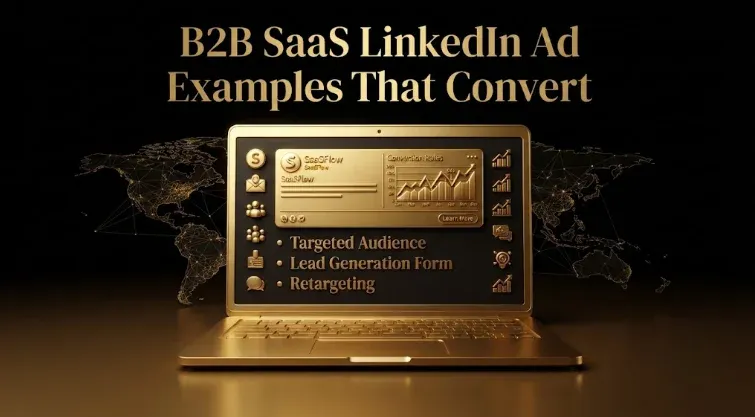
B2B SaaS LinkedIn Ad Examples That Convert (2026)
The best B2B SaaS LinkedIn ads aren’t a random gallery of clever creatives — they’re a handful of repeatable patterns, each doing one job for one funnel stage, and each built with a specific layout, headline formula, and CTA. That structure matters because most B2B ads simply don’t work: Cognism’s analysis of 761 B2B ads found only about a quarter convert at all, and B2B SaaS ads average just ~0.39% CTR while top performers hit 0.82%+ (Understory’s 2026 data). So the goal isn’t to copy one great ad — it’s to learn the archetypes that consistently earn qualified action and rebuild them for your product. Below are the B2B SaaS LinkedIn ad examples that convert, grouped by the job each does, with the real brand patterns behind them, the design specs to build your own, and what to test.
Key takeaways
- Most B2B ads fail — only ~25% convert (Cognism, 761 ads) — so proven patterns beat one-off creativity.
- The best B2B SaaS LinkedIn ads are a few archetypes, each matched to a funnel stage.
- Comparison ads are the top cold-audience performer; social proof and demo asks win warm audiences.
- Static single images out-click video (~0.42% vs 0.24%), and specific measurable claims beat vague ones.
- Judge ads on qualified action and pipeline, not CTR — a high-CTR ad that pulls junk leads isn’t a winner.
Why B2B SaaS LinkedIn ads work differently
A B2B SaaS ad sells access to business software to the person who buys or expands the seat — a buyer skimming a work feed for relevance, not entertainment. That changes what works. Static frames carry most of the load: one 2026 benchmark set put single-image CTR near 0.42% versus 0.24% for video, because a clear, scannable frame doing one job beats a polished story a busy professional won’t watch. And the difference between winners and losers is rarely production value — it’s whether the ad does a clear job for the right stage and says something specific. As Understory puts it, the most common creative mistake is vague corporate jargon: replace “AI-powered sales intelligence” with “predict customer churn 30 days earlier with 87% accuracy,” “streamline workflows” with “cut manual data entry by 15 hours a week.” Specific, measurable outcomes your ICP actually cares about are the single biggest creative lever.
The archetypes below are organized by job. Match them to your funnel — cold audiences respond to comparison, POV, and data-led ads; warm audiences respond to proof and demo asks — and benchmark each within its job (don’t judge a cold awareness ad by a bottom-funnel demo ad’s conversion rate).
1. The comparison / “vs” ad (best for cold audiences)
The comparison ad is consistently the top-performing cold-audience format on LinkedIn — you against a known alternative, or a before/after of using your product. Agencies that run it constantly (Maxiality calls it “a must-have”) point to brands like Intercom (comparison on a feeling) and Walnut (before/after of using the product), and the Cognism-vs-ZoomInfo style is widely cited as among the highest-converting warm formats too.
Build it: single image, two columns or two horizontal bars — “before/them” in grey, “after/you” in your brand color — with the dimensions buyers actually weigh, or exact figures labeled on each bar. Headline under 70 characters (e.g., “[Category]: the honest comparison” or “Cut your [metric] by [X]% in 90 days”), CTA “See the comparison” or “See the data.” Why it works: it meets an evaluating buyer with a direct answer to “which should I choose.” Test: which comparison dimensions you lead with. Keep it fair and credible — misrepresenting a competitor backfires with skeptical buyers.
2. The problem / point-of-view ad (cold audiences)
B2B SaaS buyers need to agree with the problem before they care about your product, so a strong cold ad leads with a sharp POV or a magnified pain point, not a pitch. Brands like PandaDoc are known for pain-point ads that name the problem; HockeyStack for meme/humor ads that make the point with a smile.
Build it: single image or text-led creative; open by naming the buyer’s problem in their words (“Behind on your pipeline number?”) or a provocative POV (“Most B2B SaaS teams optimize for the wrong metric”). Headline under 70 characters, low-commitment CTA (read, learn). Why it works: it establishes shared understanding and authority before asking for anything — right for a cold audience not ready for a demo. Test: the hook. The POV or pain that stops the scroll is the whole game.
3. The social-proof ad (warm audiences)
Skeptical B2B buyers trust evidence over claims, so a social-proof ad — a G2 badge, a customer logo wall, or a verified quote with a specific metric — reduces perceived risk fast. The same credibility signal that lifts landing-page conversion works inside the ad.
Build it: 1200×1200 square, G2 High Performer badge centered, client logo above, one verified customer quote below (name, title, and a concrete metric) in ~18pt, CTA embedded. Intro text under 100 characters. Why it works: third-party proof is more believable than self-promotion for a considered purchase. Format/CTA: single image; CTA to the case study or demo. Test: which proof (badge vs metric vs logo) resonates with your ICP.
4. The original-data / report ad (cold → warm)
Original data gives a buyer a genuine reason to engage — and the document ad is the ideal format for it. “We analyzed X, here’s what we found” works because it offers real, exclusive value, not a veiled pitch, and the document format lets the data breathe.
Build it: five-page document ad — cover with a credibility stat in large type (“[N] companies. $[X] in spend. Here’s what we found.”), one benchmark per page in 18pt+ high-contrast type (one idea per page, no paragraphs), final page a Lead Gen Form. Cover headline under 60 characters. Why it works: exclusive data is worth exchanging information for, and it repurposes into organic posts, decks, and nurture. Format/CTA: document ad + Lead Gen Form (or landing page if the report needs explanation). Test: the cover stat — it’s the hook. This is where your own benchmark data becomes uncopyable ad fuel.
5. The thought-leader ad (cold audiences)
A founder or expert’s post, promoted as a Thought Leader Ad, out-performs brand ads because it’s a real person’s authentic voice — 2026’s fastest-growing format. Vertical-specific language in a TLA also works as an ICP filter: it repels poor-fit audiences and attracts exact-fit buyers (SaaSHero cites a Leasecake TLA whose vertical jargon did exactly that).
Build it: the founder’s genuine take on a specific problem in your buyers’ world, in their own voice, promoted from their profile — not a brand-polished post. Soft CTA. Why it works: people trust people over brands, and specificity signals real expertise. Test: which founder/expert angle earns the most qualified engagement.
6. The stat / results ad (warm audiences)
A single, bold, specific number carries an entire ad — because a concrete result is more persuasive than any adjective. SaaSHero points to Stripe’s bold revenue-growth claim and Amplitude’s conversion-lift figure as 2026 benchmarks for this; efficiency metrics like “10x lower CPL” outperform feature claims for audiences already running paid.
Build it: giant ROI callout in the first visual frame (“$504K ARR,” “80-day payback,” “10x lower CPL”), high-contrast, product screenshot in the lower third, no stock photography. Headline follows [Number] + [Benefit]; intro under 150 characters; CTA “See the data.” Why it works: a specific, quantified number is tangible and credible, and the visual does the work. Test: which metric leads.
7. The demo / bottom-funnel ad (warm audiences)
For warm, sales-ready audiences, a direct demo or trial ad converts — but only on audiences that already know you (asking a cold audience for a demo mostly fails). A checklist ad (benefits as checkmarks, DoorDash-style) also works well here for feature-ready buyers.
Build it: clean product-UI visual (real screenshot, not stock), headline stating the concrete outcome the demo delivers ([Benefit] for [Persona]), CTA “Book a demo” or “Start a trial,” often via Lead Gen Form. Why it works: it meets a ready buyer with the next step. Test: the offer — demo vs trial vs consultation — against your audience.
The archetypes at a glance
| Archetype | Best for (stage) | Format | Real patterns | Test |
|---|---|---|---|---|
| Comparison / “vs” | Cold | Single image / carousel | Intercom, Walnut, Cognism-vs-ZoomInfo | Comparison dimensions |
| Problem / POV | Cold | Single image / text | PandaDoc, HockeyStack | The hook |
| Social proof | Warm | Single image | G2-badge + quote ads | Which proof resonates |
| Original data | Cold→warm | Document ad + form | Benchmark-report ads | The cover stat |
| Thought-leader | Cold | Thought Leader Ad | Founder POV (Leasecake) | The expert angle |
| Stat / results | Warm | Single image | Stripe, Amplitude | The lead metric |
| Demo / checklist | Warm | Single image / video | DoorDash checklist | The offer |
How to build your own (and the carousel note)
Start from the job, not the format. Pick the funnel stage and audience, choose the archetype that does that job, then build the creative around one clear message, one hook, one CTA — and one specific, measurable claim instead of vague jargon. Keep the visual scannable (the ad’s job is to stop the scroll and earn the click; the landing page tells the full story), use real product UI over stock photography, and lead with your strongest element (the comparison, the stat, the proof, the POV). Match format to message: static single images win for one-idea messages, while carousels roughly double CTR for multi-point stories — and in a carousel, later cards can out-perform the first, so every card must earn the next swipe (a 5-card arc: pattern-interrupt stat → pain → solution → customer result → CTA).
Above all, judge these on the right metric. A high-CTR ad that produces cheap, unqualified leads isn’t a winner — Document Ads, for instance, convert better than their CTRs suggest, which proves optimizing for CTR alone misses the point. The archetypes that matter are the ones that earn qualified action and pipeline, matched to the buyer’s stage. [INSERT: swap the described patterns for real annotated screenshots of your own top-performing ads — a "here's the actual ad and its result" version, with your data, will out-rank and out-earn any text-only post.]
Frequently Asked Questions
Q1. What makes a good B2B SaaS LinkedIn ad?
One that does a clear job for a specific funnel stage and says something specific — not one that’s merely polished. The best B2B SaaS ads fall into archetypes (comparison, problem/POV, social proof, original data, thought-leader, stat/results, demo), each matched to cold or warm audiences. A good ad leads with one strong element and one measurable claim (not vague jargon), keeps the visual scannable with one CTA, uses real product UI over stock, and earns qualified action — judged on pipeline, not CTR.
Q2. What type of LinkedIn ad converts best for B2B SaaS?
For cold audiences, comparison (“vs”) ads are consistently the top performer, followed by problem/POV and original-data ads. For warm audiences, social proof, stat/results, and demo ads convert best. The pattern is matching the archetype to the buyer’s stage — cold buyers need to agree with the problem or see a clear comparison before the pitch, while warm buyers respond to proof and clear asks. Comparison ads in particular are widely cited as a must-have.
Q3. Do static images or video convert better on LinkedIn for B2B?
Static usually wins for clicks — one 2026 benchmark set put single-image CTR near 0.42% versus 0.24% for video — because B2B buyers skim work feeds and a clear static frame doing one job beats a story they won’t watch. Video has its place for engagement and demos, and carousels roughly double CTR for multi-point stories. So format should follow the message: static for one idea, carousel for a sequence, video where motion genuinely helps.
Q4. What should a B2B SaaS ad headline say?
Something specific and measurable, not vague. Replace jargon like “AI-powered platform” with a concrete outcome (“predict churn 30 days earlier with 87% accuracy,” “cut manual data entry 15 hours a week”). Proven formulas include [Number] + [Benefit] (“10x lower CPL”) and [Benefit] for [Persona], kept under ~70 characters. Specific, quantified claims outperform feature claims and category jargon, because they’re credible and legible in the two seconds a buyer gives the ad.
Q5. Why do most B2B SaaS ads fail?
Because they don’t do a clear job for the right stage, or they use vague claims — only about a quarter of B2B ads convert (Cognism, 761 ads), and B2B SaaS averages ~0.39% CTR. The failures are usually strategy, not production: a cold-audience ad asking for a demo, a cluttered visual with no single hook, generic jargon instead of a measurable outcome, or an ad optimized for CTR that pulls unqualified leads. Winners pick one archetype, one message, one specific claim.
Q6. What’s the best cold-audience LinkedIn ad for B2B SaaS?
The comparison ad — you versus a known alternative, or a before/after of using your product — is consistently the top cold-audience performer, because it gives a not-yet-committed buyer a concrete reason to reconsider. Problem/POV ads and original-data (document) ads also work cold, because they lead with value or a point of view rather than a pitch. Save demo asks for warm audiences; cold audiences need to agree with the problem first.
Q7. How do you make a social-proof ad work?
Lead with credible, specific proof: a G2 badge, a customer logo, or a verified quote that includes the customer’s name, title, and a concrete metric — placed where it reduces risk fastest. The credibility signal that lifts landing-page conversion works inside the ad too. Keep intro copy short and the CTA pointed at the case study or demo. Test which proof element (badge, metric, or logo) resonates most with your ICP.
Q8. How should you judge LinkedIn ad performance?
On qualified action and pipeline, not CTR. A high-CTR ad that produces cheap, unqualified leads isn’t a winner — and some of the best formats (like Document Ads) convert better than their CTRs suggest, proving CTR alone misses the point. Benchmark each ad within its job (don’t compare a cold awareness ad to a bottom-funnel demo ad), test the highest-leverage element (usually the hook, the claim, or the offer) one variable at a time, and keep the winners.
More Featured Blogs
View All Blogs
LinkedIn Ads Optimization Checklist & Routine for B2B SaaS (Daily, Weekly, Monthly)


How to Audit Your LinkedIn Ads Account (B2B SaaS Teardown)