Quick Summary
Summarize this article instantly with your preferred AI model.
B2B SaaS Buyer Journey Mapping with LinkedIn Attribution: 88 Touchpoints, 4 Channels, 10 Stakeholders, 281 Days (2026)
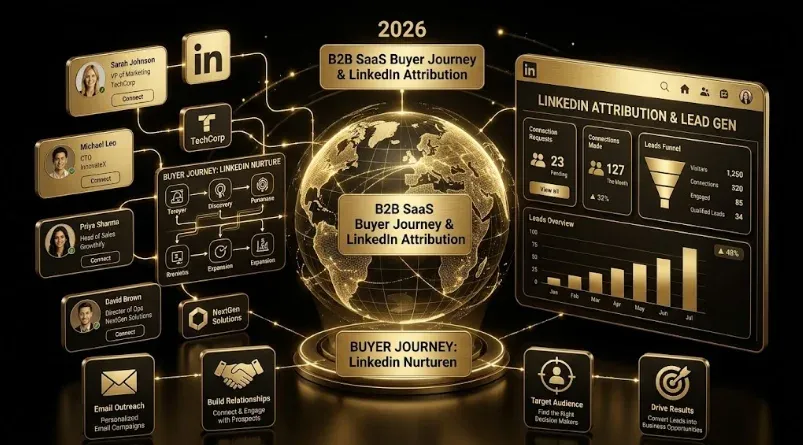
The average B2B SaaS buyer journey involves 88 touchpoints across 4 channels with 10 stakeholders, spanning 281 days from first touch to closed-won (Dreamdata 2026 LinkedIn Ads Benchmarks Report). This buyer journey complexity is why short-window attribution (7-day, 30-day) systematically underestimates LinkedIn’s contribution — LinkedIn touches occur early (months 1-6 of the 9-month average cycle) while conversions land later. The right buyer journey mapping requires: (1) full-cycle attribution windows (180-365 days minimum), (2) multi-touch attribution platforms (Dreamdata, HockeyStack, HubSpot multi-touch), (3) account-level attribution capturing all 10 stakeholders, (4) cross-channel measurement integrating LinkedIn + Google + email + direct/organic + community channels. Without this infrastructure, LinkedIn appears to “underperform” because it shapes early demand that other channels capture credit for later.
Key Takeaways
- B2B SaaS buyer journeys involve 88 touchpoints, 4 channels, 10 stakeholders, 281 days (Dreamdata 2026 benchmark).
- Standard 7-30 day attribution windows miss 80-90% of LinkedIn’s contribution because cycles average 281 days.
- The 10-stakeholder buying committee means single-contact attribution misses 9 of 10 influencers.
- LinkedIn touches typically occur in months 1-6; conversions land in months 7-9 — creating false “underperformance” signal.
- Multi-touch attribution platforms (Dreamdata, HockeyStack, HubSpot multi-touch) are mandatory for accurate B2B SaaS journey mapping.
- Account-level attribution captures the full buying committee; contact-level attribution misses most of the journey.
The Buyer Journey Reality
For years, B2B marketers operated under simplified buyer journey assumptions: prospect sees ad → fills form → talks to sales → buys. The Dreamdata 2026 data definitively destroys this model.
The actual B2B SaaS buyer journey:
| Dimension | 2026 Benchmark | Implication |
|---|---|---|
| Total touchpoints | 88 per closed deal | Multiple ads, emails, content pieces, organic visits, sales calls |
| Channels involved | 4 unique channels | LinkedIn + Google + Email + Direct/Organic minimum |
| Stakeholders engaged | 10 per deal | Buying committee complexity |
| Days from first touch to closed-won | 281 days median | 9+ month sales cycles |
| First-touch channel attribution | LinkedIn dominates | LinkedIn often starts journeys |
| Last-touch channel attribution | Google/Direct dominate | Google captures later in journey |
This complexity is why naive attribution models produce misleading conclusions:
- Last-click attribution: undercredits LinkedIn by 40-60% (LinkedIn is rarely the final click)
- First-click attribution: overcredits LinkedIn but misses middle-funnel influence
- Single-contact attribution: misses 9 of 10 stakeholders in buying committee
- 30-day attribution windows: miss 80-90% of conversions on 281-day cycles
- Browser-only tracking: misses 30-50% of conversions (long cycles + cross-device + privacy)
The result: most B2B SaaS underinvests in LinkedIn because their attribution can’t measure its actual contribution.
The Standard B2B SaaS Journey Stages
Mapping the 88 touchpoints into stages:
| Stage | Time in Journey | Typical Touchpoints | LinkedIn Role |
|---|---|---|---|
| Stage 1: Unaware | Months 0-3 | LinkedIn thought leadership, podcasts, organic content | LinkedIn primary |
| Stage 2: Problem Aware | Months 1-5 | LinkedIn Document Ads, industry reports, peer conversations | LinkedIn primary |
| Stage 3: Solution Aware | Months 3-7 | LinkedIn comparison content, G2 research, vendor websites | LinkedIn supporting |
| Stage 4: Vendor Selection | Months 5-8 | Demo requests, sales conversations, peer references | LinkedIn supporting |
| Stage 5: Evaluation | Months 7-9 | Trial/POC, technical evaluation, security review | Sales-led |
| Stage 6: Decision/Procurement | Months 8-9 | Contract negotiation, legal review, executive sponsorship | Sales-led |
| Stage 7: Closed-Won | Month 9+ | Implementation, onboarding | Customer success |
Key insight: LinkedIn dominates Stages 1-3 (the first 5-7 months) but rarely appears as the last touchpoint. Without multi-touch attribution, LinkedIn’s actual contribution is invisible — and unfunded.
The 10-Stakeholder Buying Committee
The “10 stakeholders” stat dramatically reshapes how to think about attribution. The typical B2B SaaS buying committee composition:
| Role | Function | Typical Touchpoints |
|---|---|---|
| End User Champion | Daily product user | LinkedIn content, peer recommendations, product reviews |
| Department Manager | Functional owner | Industry research, comparison content, demos |
| VP/Director (Buyer) | Functional decision-maker | Strategic content, customer references, ROI analysis |
| CXO Sponsor | Executive sponsor | Thought leadership, peer CEO conversations, board reporting |
| IT Stakeholder | Technical evaluator | Architecture content, integration docs, security review |
| Security Officer | Security/compliance review | Compliance documentation, security frameworks |
| CFO/Finance | Budget approver | ROI analysis, contract terms, payback period |
| Procurement | Process owner | Vendor management, contracts, MSAs |
| Legal | Contract reviewer | Terms, liability, data handling |
| End-User Coalition | Multiple individual users | Product trial experience, internal champions |
Each stakeholder has their own information needs and decision criteria. Marketing that reaches only one stakeholder (e.g., only the buyer VP) misses 9 of 10 decision influencers.
The implication for LinkedIn targeting: ABM with persona-specific creative outperforms single-persona campaigns by 2-3x because it engages multiple committee members in parallel.
The 4-Channel Reality
B2B buyer journeys average 4 channels because no single channel reaches all 10 stakeholders across all 7 journey stages:
| Channel | Primary Role | Stakeholder Coverage |
|---|---|---|
| Demand creation + awareness + ABM | Broad — all stakeholders use professionally | |
| Google (Search) | Demand capture + research | Strong — all stakeholders search when researching |
| Nurture + relationship | Strong — established connections receive | |
| Direct/Organic | Brand familiarity expression | Indicates demand gen worked |
| G2/TrustRadius | Peer validation | Strong for end users + buyers |
| Industry events | Community + authority | Strong for executives + practitioners |
| Outbound (SDR) | Direct engagement | Strong for buyers + champions |
| Community channels | Peer influence | Strong for specific roles (devs on Reddit, etc.) |
The 4-channel average usually involves: LinkedIn + Google + Email + Direct/Organic. More mature programs use 6-8 channels. The implication: LinkedIn standalone strategies underperform multi-channel approaches.
For cross-channel comparison, see LinkedIn vs Meta vs Reddit.
The 281-Day Cycle and Attribution Implications
The 281-day median cycle creates structural attribution problems:
The math:
- LinkedIn first touch: Day 0
- Initial form fill / engagement: Day 30-90
- MQL designation: Day 60-120
- SQL handoff: Day 90-150
- Active opportunity: Day 120-200
- Demo / POC: Day 180-240
- Decision / procurement: Day 240-281
- Closed-won: Day 281+
LinkedIn’s standard 7-30 day attribution window captures only the first 1-2 stages. It cannot connect Day 281 closed-won back to Day 0 LinkedIn impression.
The fixes:
- Extend click-through windows: Set LinkedIn click windows to 30+ days (90 days for enterprise B2B)
- CAPI integration: Send pipeline events (MQL, SQL, Opp, CW) back to LinkedIn via Conversions API
- Multi-touch attribution platform: Dreamdata/HockeyStack/HubSpot for full-journey credit
- Account-level matching: Match impressions to closed-won at the company level, not contact level
- Branded search tracking: Use Google branded search as dark funnel proxy for LinkedIn brand impact
See LinkedIn Dark Funnel guide for complete attribution architecture.
How to Map Your Own Buyer Journey
Practical buyer journey mapping for B2B SaaS:
Step 1: Define your stages.
Use the 7-stage model above as starting point. Customize based on your sales motion:
- PLG-led products: collapse Stages 5-6 into one (trial → paid)
- Enterprise sales-led: expand Stages 5-6 to multiple sub-stages
- Inbound-heavy: emphasize Stages 1-3 (where inbound builds)
- Outbound-led: emphasize Stages 4-6 (where outbound enters)
Step 2: Map touchpoints per stage.
For each stage, list:
- What content/experience moves prospects through this stage?
- Which channels deliver this content?
- Which stakeholders engage in this stage?
- What does success look like for this stage?
Step 3: Identify gaps.
Common gaps:
- Stage 1-2 underinvestment (demand gen deficit)
- Stage 3 weak comparison content (lose to competitors with stronger positioning)
- Stage 4 weak BDR/sales process
- Stage 5-6 long contract cycles (procurement delays)
Step 4: Map stakeholders to touchpoints.
For each stakeholder (the 10 committee members), identify:
- What content/touchpoints reach them at each stage?
- Are you missing any stakeholders entirely?
- Which stakeholders have low engagement coverage?
Step 5: Build attribution infrastructure.
To measure the journey accurately, you need:
- LinkedIn Insight Tag site-wide
- LinkedIn CAPI for server-side pipeline events
- Multi-touch attribution platform (Dreamdata, HockeyStack, HubSpot multi-touch)
- Account-level reporting (not just contact-level)
- Long attribution windows (180-365 days)
Cross-Channel Journey Patterns
Common B2B SaaS buyer journey patterns by GTM motion:
PLG-led journey:
Stage 1: LinkedIn thought leadership → Individual developer
Stage 2: Free trial signup → Product experience
Stage 3: Team adoption → Multiple users
Stage 4: Hits free tier limits → CFO/CTO conversation
Stage 5: Procurement → Annual contract
Cycle: 30-180 days. Fewer touchpoints (typically 40-60 vs 88). LinkedIn role: top-of-funnel awareness + retargeting of trial signups.
Enterprise sales-led journey:
Stage 1: LinkedIn awareness → CXO sponsor identifies category
Stage 2: Research initiated → Industry reports, peer conversations
Stage 3: Initial vendor list → Demo requests
Stage 4: Vendor shortlist → POC/evaluations
Stage 5: Vendor selection → Reference checks
Stage 6: Procurement → Contract negotiation
Stage 7: Implementation → Closed-won
Cycle: 281-540 days. 88+ touchpoints. LinkedIn role: dominant in Stages 1-3, supporting in Stages 4-6.
ABM-led journey:
Stage 1: Target account identification → Coordinated multi-channel
Stage 2: Account warming → LinkedIn + email + direct mail + outbound
Stage 3: Engagement triggered → Sales outreach initiated
Stage 4: Buying committee engaged → Multi-stakeholder content
Stage 5: Evaluation → POC + reference + technical
Stage 6: Decision → Executive engagement
Stage 7: Closed-won → Implementation
Cycle: 180-365 days. 60-120 touchpoints. LinkedIn role: dominant throughout — primary ABM channel.
Attribution Models for B2B Buyer Journey
Different attribution models tell different stories about LinkedIn’s role:
| Model | LinkedIn Credit | Use Case |
|---|---|---|
| Last-click | 5-15% | Misleading for B2B; defaults to Google/Direct |
| First-click | 30-50% | Overcredits LinkedIn for early-stage touches |
| Linear (equal weight) | 25-30% | Balanced but doesn’t reflect actual influence |
| U-shaped (40/20/40) | 25-35% | Weights first + last touch heavily |
| W-shaped (30/30/30 + 10) | 30-40% | First + MQL + Opportunity + others |
| Time-decay | 15-25% | Weights recent touches more |
| Data-driven (ML-based) | 30-50% | Most accurate but requires Dreamdata/HockeyStack |
For B2B SaaS, W-shaped or data-driven attribution is recommended. These models correctly assign credit to the early-stage touchpoints (often LinkedIn) that shape demand, plus the conversion touchpoints (often Google/Direct) that capture it.
Common Buyer Journey Mapping Mistakes
Mistake 1: Assuming linear journeys. Real journeys are non-linear — prospects move back and forth between stages, engage and disengage, restart evaluations after months of dormancy. Map for reality, not idealization.
Mistake 2: Single-contact attribution. Tracking only the form-filler ignores the 9 other buying committee stakeholders. Use account-level attribution that captures all decision influencers.
Mistake 3: Short attribution windows. 7-day, 30-day windows can’t capture 281-day cycles. Extend windows to 180-365 days minimum.
Mistake 4: Channel attribution in isolation. LinkedIn isolated from Google/email/community channels misses the cross-channel reality. Use multi-touch attribution that crosses channels.
Mistake 5: Treating B2B like B2C journeys. B2B has more touchpoints (88 vs 20-30 for B2C), more stakeholders (10 vs 1-2), and longer cycles (281 days vs 30 days). Apply B2B-specific attribution.
Mistake 6: Defunding “underperforming” channels. Channels that appear underperforming on last-click attribution often dominate first-touch. Verify with multi-touch before defunding.
Mistake 7: No account-level reporting. Tracking contacts but not accounts misses the buying committee reality. Account-level reporting reveals which target organizations are actually engaging.
Mistake 8: Ignoring dark funnel. Direct traffic, branded search lift, and inbound demo requests without source attribution are demand gen working. Measure these explicitly.
How OLA Maps the LinkedIn Portion of B2B Journeys
OLA’s optimization layer supports buyer journey attribution:
- Account-level engagement tracking — see which target accounts received impressions, view rates, click rates across the journey
- HubSpot CAPI integration — sends pipeline events (MQL, SQL, Opp, CW) back to LinkedIn so the algorithm optimizes for downstream events, not form fills
- Audience layering — combine 1st-party signal (engagement) with target account lists for compound targeting matching journey stages
- Multi-touch enablement — works with Dreamdata, HockeyStack, HubSpot multi-touch for full-journey credit
Flat $29/month per Ad Account. 15-minute setup. Works for B2B SaaS teams running multi-channel journey attribution.
For teams wanting full buyer journey orchestration + attribution + cross-channel measurement, GrowthSpree’s managed service wraps OLA into a $3,000/month flat engagement — month-to-month, HubSpot-native.
FAQs
How many touchpoints does a B2B SaaS buyer journey involve?
The average B2B SaaS buyer journey involves 88 touchpoints across 4 channels with 10 stakeholders, spanning 281 days from first touch to closed-won (Dreamdata 2026 LinkedIn Ads Benchmarks Report). PLG-led journeys average fewer (40-60 touchpoints, 30-180 days). Enterprise sales-led journeys average more (100+ touchpoints, 365-540 days). The complexity is why simple attribution models fail for B2B.
How long is the average B2B SaaS sales cycle?
The Dreamdata 2026 benchmark shows 281 days median from first LinkedIn ad impression to closed-won for B2B SaaS. This varies significantly by ACV: SMB B2B SaaS 60-180 days, Mid-Market 90-180 days, Enterprise 180-365 days, Enterprise complex (healthcare IT, large security tools) 365-540+ days. The 281-day median is why short-window attribution (7-30 days) systematically underestimates LinkedIn’s contribution.
How many stakeholders are in a typical B2B SaaS buying committee?
Dreamdata 2026 benchmark shows 10 stakeholders per deal on average. Smaller B2B deals (sub-$25K ACV) involve 4-6 stakeholders. Enterprise deals involve 12-15. Healthcare IT specifically has the largest committees at 15-22 stakeholders. The 10-stakeholder average means targeting only one role (the buyer) misses 9 other decision influencers.
Why does last-click attribution underrepresent LinkedIn?
Last-click attribution undercredits LinkedIn because LinkedIn typically touches prospects in Stages 1-3 of the buyer journey (months 1-6 of a 9-month cycle) — building awareness and consideration. Final conversions usually happen via Google Search (branded search), direct traffic, or sales conversations later. Last-click gives credit to the final touchpoint, missing 40-60% of LinkedIn’s actual contribution. Use multi-touch attribution (W-shaped, data-driven) instead.
What attribution model should I use for B2B SaaS?
For B2B SaaS, W-shaped attribution (credits first touch, MQL conversion, Opportunity creation, plus other touches) or data-driven attribution (ML-based via Dreamdata, HockeyStack, HubSpot multi-touch) are recommended. Last-click systematically undercredits demand gen channels like LinkedIn. First-click overcredits early channels. Linear is balanced but doesn’t reflect actual influence. The best practice: data-driven attribution from a multi-touch platform.
How do I track 281-day buyer journeys with LinkedIn?
For 281-day journey attribution: (1) Extend LinkedIn click-through windows to 30-90 days, (2) Implement LinkedIn CAPI to send pipeline events (MQL, SQL, Opp, CW) server-side from your CRM, (3) Use multi-touch attribution platform (Dreamdata, HockeyStack, HubSpot multi-touch) for cross-channel journey mapping, (4) Track account-level engagement (not just contact-level) to capture buying committee, (5) Use branded search trends as dark funnel signal.
What does account-level attribution mean for B2B?
Account-level attribution tracks engagement at the company level rather than just the individual contact. For B2B with 10-stakeholder buying committees, contact-level attribution misses 90% of decision influencers. Account-level attribution captures all 10 stakeholders’ touchpoints, providing accurate view of how marketing influences buying decisions across the committee.
Why do B2B SaaS buyer journeys involve 4 channels?
B2B SaaS buyer journeys involve 4 channels (Dreamdata 2026 median) because no single channel reaches all 10 stakeholders across all 7 journey stages. LinkedIn reaches decision-makers professionally; Google captures research-stage demand; Email maintains relationship through long cycles; Direct/Organic reflects brand familiarity. Each plays a specific role. LinkedIn-only strategies underperform multi-channel approaches.
Map Your B2B Buyer Journey with LinkedIn Attribution
Connect OLA + HubSpot. The reporting shows full buyer journey attribution from first LinkedIn touch through closed-won, including account-level engagement, multi-channel touchpoint mapping, and cycle-length analysis. Most teams discover LinkedIn drives 2-3x more pipeline than last-click reporting credits.