Quick Summary
Summarize this article instantly with your preferred AI model.
How to Use AI for LinkedIn Audience & ICP Research
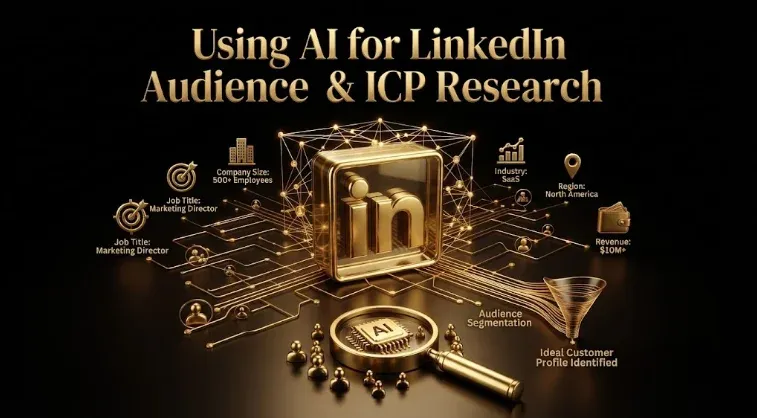
How to Use AI for LinkedIn Audience & ICP Research
The fastest way to sharpen your LinkedIn targeting isn’t guessing at job titles — it’s using AI to analyze your best customers, surface the firmographic and technographic patterns you’d miss manually, and translate those into precise LinkedIn targeting and exclusions. This matters because a sharp ICP is the highest-leverage decision in B2B: companies with a documented, data-driven ICP close deals about 68% faster (Gartner), yet roughly 42% of B2B companies run an ICP that’s either too broad or too narrow — and B2B teams waste up to 40% of spend chasing leads that never convert. AI is genuinely good at finding non-obvious patterns across closed-won data (a specific size band converting at 3x, say) that no human spots by eye. But AI finds patterns; humans validate whether they reflect genuine fit; and you judge the resulting audience on pipeline. This guide covers the workflow, the LinkedIn translation, and the guardrails.
Key takeaways
- A data-driven ICP closes deals ~68% faster — and ~42% of B2B companies have a miscalibrated one.
- Use AI to find patterns in your best vs poor-fit customers — contrast, not averages.
- Translate patterns into LinkedIn targeting — titles, functions, seniority, company size, company lists, and exclusions.
- ICP is the company; personas are the roles — target the economic, technical, user, and champion buyers within it.
- AI finds; humans validate; pipeline decides — validate with intent data and judge the audience on pipeline, not size.
What AI can (and can’t) do for audience research
AI is genuinely useful for the pattern-finding and data work of ICP research. It can analyze your closed-won data to surface non-obvious correlations across many variables at once (industry, size, tech stack, growth, region), score accounts against a fit model, enrich missing data, and keep the profile current as new data arrives — replacing the manual enrichment cycle where data goes stale before you finish updating it (companies that keep customer data updated see roughly 20% higher conversion). It can’t reliably supply the judgment that separates a real pattern from a spurious one: whether “companies using X convert well” reflects genuine product fit or just who you sold to last quarter, or whether a segment is strategically worth pursuing. So the model is: AI surfaces patterns; humans decide which are real and worth targeting. AI is most valuable used to find non-obvious patterns in closed-won data, not to confirm what you already assumed.
The workflow
Use AI inside a workflow that ends in LinkedIn targeting and is validated on pipeline:
- Export your data (human) — pull your best customers (top 20–30% by retention, expansion, referrals, or ROI) and, crucially, poor-fit or churned accounts for contrast.
- Find patterns (AI) — have AI analyze the contrast between best-fit and poor-fit across firmographics, technographics, and behavior — what distinguishes them, not the average.
- Validate (human) — decide which patterns reflect genuine fit versus temporary conditions, and which segments are worth targeting.
- Build the TAM (human + AI) — turn the validated ICP into a verified Total Addressable Market: a list of companies that genuinely match, rather than relying on native platform filters alone.
- Translate to LinkedIn targeting — convert patterns into LinkedIn parameters (titles/functions, seniority, company size, industry, and company lists) plus exclusions for the non-ICP segments.
- Measure and refine — judge on cost per SQL and pipeline (not audience size or CTR), validate against intent data, and re-run the analysis every ~90 days, since a static ICP drifts.
Human-data → AI-patterns → human-validation → TAM → LinkedIn-targeting → pipeline-measurement → refresh. AI compresses the analysis; judgment and translation stay human.
ICP vs personas: target the buying committee
A common mistake is conflating the ICP with who you target in the ad. The ICP is the company — the firmographic/technographic profile of the accounts that buy, stay, and expand. The personas are the roles inside those companies, and B2B purchases involve a committee: typically the economic buyer (controls budget), the technical buyer (evaluates and can veto), the user buyer (uses it daily), and the champion (the internal advocate). On LinkedIn, you use the ICP to define which companies to reach (company size, industry, company lists) and the personas to define which people within them (titles, functions, seniority) — often running separate campaigns for different personas with tailored messaging. AI helps here too: it can surface which roles show up in your best closed-won deals and how the committee composition differs by segment. Getting this two-layer targeting right — right companies, right roles within them — is what precise LinkedIn targeting actually means.
Translating ICP into LinkedIn targeting
This is the step generic ICP guides skip and where the value is for advertisers: turning the profile into precise LinkedIn parameters. Map each validated pattern to a dimension — role patterns to titles and functions plus seniority; company patterns to company size, industry, and (best of all) an uploaded list of named best-fit accounts; tech-stack patterns to company lists built from technographic data. Just as important, build exclusions from the poor-fit patterns, because LinkedIn’s native targeting is broader than it looks and misclassifies companies — you might target SaaS platforms and reach custom software agencies that build tools for clients instead, inflating your audience with unqualified accounts and driving up cost. AI-derived exclusions and named company lists counter that. The result is targeting grounded in what your best customers actually share — far sharper than the “B2B SaaS, 50–500 employees” guess most accounts run on, and a direct antidote to the wasted-spend problem.
The guardrails
Four guardrails keep AI audience research honest. Contrast, not averages: analyze best-fit versus poor-fit for what distinguishes them — the average of your customers isn’t your ideal customer. AI finds, humans validate: decide whether a pattern reflects genuine fit or a temporary condition before targeting on it; AI can confidently surface a coincidental correlation. Validate with intent data: intent signals are the layer that connects ICP assumptions to real in-market behavior, letting you see whether the right accounts are actually researching your category. Judge on pipeline and refresh: measure the audience on cost per SQL and pipeline (not size or CTR), and re-run the analysis every ~90 days against fresh closed-won data. And keep two tracks in mind: since roughly 95% of B2B buyers are out-of-market at any moment, use your sharp ICP for both brand-building to seed memory with high-value segments and performance targeting to capture in-market intent. Used this way, AI makes your LinkedIn targeting sharper and more current than manual research could, while human judgment keeps it grounded in real fit and pipeline keeps it honest.
Frequently Asked Questions
Q1. How do you use AI for ICP and audience research?
Export your best customers plus poor-fit/churned ones, have AI find the patterns that distinguish them (contrast, not averages), validate as a human which reflect genuine fit, build a verified TAM, translate the patterns into LinkedIn targeting (titles, functions, seniority, company size, company lists) plus exclusions, then measure on cost per SQL and pipeline. Validate against intent data and re-run every ~90 days. AI compresses the analysis; the judgment, TAM, and LinkedIn translation stay human.
Q2. Does a data-driven ICP actually improve results?
Yes, measurably — companies with a documented, data-driven ICP close deals about 68% faster (Gartner), because they waste fewer touchpoints and get better message-market fit. Yet roughly 42% of B2B companies run an ICP that’s too broad or too narrow, and B2B teams waste up to 40% of spend on leads that never convert. So sharpening the ICP with AI-analyzed closed-won data — and translating it into precise targeting and exclusions — directly attacks both the speed and the waste problems.
Q3. What’s the difference between an ICP and a persona for targeting?
The ICP is the company profile (firmographics/technographics of accounts that buy, stay, and expand); personas are the roles within those companies. B2B purchases involve a committee — economic buyer, technical buyer, user buyer, champion — so on LinkedIn you use the ICP to define which companies to reach (size, industry, company lists) and personas to define which people within them (titles, functions, seniority), often with separate campaigns per persona. Getting both layers right is what precise targeting means.
Q4. How do you turn an ICP into LinkedIn Ads targeting?
Map each validated pattern to a LinkedIn dimension: role patterns to titles/functions plus seniority; company patterns to size, industry, and an uploaded list of named best-fit accounts; tech-stack patterns to company lists from technographic data. Then build exclusions from the poor-fit patterns, because LinkedIn’s native targeting misclassifies companies and inflates your audience (targeting SaaS platforms but reaching software agencies, say). The result is targeting grounded in what your best customers share — far sharper than a generic size-band guess.
Q5. Why analyze for contrast instead of averages?
Because the average of your customers isn’t your ideal customer — averages blend your best and worst accounts into a vague middle. Comparing best-fit against poor-fit reveals what genuinely distinguishes the accounts that convert, retain, and expand from those that don’t, which is what you want to target (and exclude). A contrast analysis produces a sharp, actionable ICP; an average produces the generic profile that wastes ad spend on non-buyers. Feed AI both cohorts and ask specifically for what separates them.
Q6. What data should you feed AI for audience research?
Your closed-won data — your best customers (top 20–30% by retention, expansion, referrals, or ROI) and a set of poor-fit or churned customers for contrast — including firmographics (size, industry, region, growth), technographics (tech stack), and behavior where available. Keeping this data updated matters: companies with current customer data see roughly 20% higher conversion, and AI can refresh the profile continuously. The contrast between best and worst is where the useful, targetable patterns come from.
Q7. How does intent data fit into AI ICP research?
Intent data is the validation layer that connects your ICP assumptions to real in-market behavior — it lets you see, in near real time, whether the accounts your ICP says are ideal are actually researching your category. So after AI derives and you validate the ICP, intent signals confirm whether those accounts are in-market now (worth performance targeting) or not yet (worth brand-building). Since ~95% of B2B buyers are out-of-market at any time, intent data helps you split effort between seeding memory and capturing active demand.
Q8. How often should you update your ICP with AI?
Roughly every 90 days — pull your latest closed-won data and re-run the analysis, because a static ICP built on historical assumptions drifts out of alignment with your actual best-fit buyers as your market and product evolve. Most ICPs are built once, filed away, and ignored, so campaigns keep targeting stale segments no one has questioned. Treating the ICP as a living document, refreshed quarterly with AI-assisted analysis and validated against intent data, keeps your LinkedIn targeting accurate over time.
More Featured Blogs
View All Blogs
LinkedIn Ads Account Structure & Naming Convention for B2B SaaS


AI vs Human LinkedIn Ad Copy: Which Wins?
How to Use AI for LinkedIn Ad Creative (Without Producing Junk)